The modern world stands on the precipice of a fundamental transformation in labor markets and the very mechanisms of value creation. Generative AI is evolving beyond simple tooling, transitioning toward fully autonomous agents capable of independently tackling complex cognitive challenges. Anthropic has released a comprehensive analysis outlining the potential trajectories of this transition through 2030. At the heart of the discussion is the precarious balance between an explosion of global prosperity and the systemic risk of displacing human intelligence on a massive scale.
Forecasting the economic impact of artificial intelligence today is reminiscent of trying to predict the fallout of the Industrial Revolution in its earliest stages. The pivotal question is not the raw computational power of the models themselves, but rather the velocity and depth of their integration into operational business processes. Depending on these variables, the trajectory of development could diverge into three distinct paths: ranging from a measured evolution to a radical rupture with our traditional conception of labor.
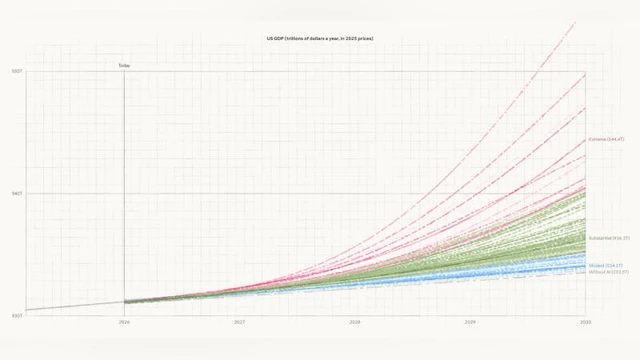
The first, "restrained" scenario, frames AI as the logical progression of digitalization. In this model, the economic impact of AI is comparable to that of the internet's emergence. We would witness the introduction of new products, the optimization of legacy services, and a gradual transformation of specific sectors, while the overarching structure of the labor market remains stable. Innovation would unfold at historical paces, avoiding social upheaval, with economic gains distributed in a smooth and predictable manner.
A more optimistic, yet more unsettling "substantial" scenario posits that by 2030, AI will assume up to half of all cognitive labor. This represents a qualitative shift: systems evolve from mere "assistants" into autonomous agents. While humans would still handle the bulk of routine tasks, operational efficiency would surge to the point where US GDP growth could double, hitting annual rates of 4–5%. This is the era of hybrid intelligence, where humans orchestrate autonomous systems, delegating a substantial portion of the cognitive load.
The most radical is the "extreme" scenario. In this model, AI does not merely augment human capability but surpasses it across the vast majority of intellectual tasks, fully replacing specialists through autonomous operation. The result is a paradox: an economic explosion coupled with a social crisis. GDP growth accelerates to 15% annually, doubling every four and a half years, leading to an overall increase in societal wealth. However, the cost of this progress is an unprecedented surge in white-collar unemployment. Software engineers, analysts, and managers would see their traditional roles vanish, making the search for new niches for human labor a critical challenge.
Industry sentiment analysis reveals that most experts lean toward a moderately optimistic outlook. Surveys indicate that the "substantial" model is the prevailing expectation. The majority of respondents believe that by 2030, AI will drive a 10% increase in GDP relative to the baseline scenario, while unemployment remains within a manageable 5%. Nevertheless, approximately 10% of participants believe the world is trending toward extreme transformation, underscoring the presence of significant risks even within the professional community.
 The Phenomenon of Chinese 96GB AI Accelerators