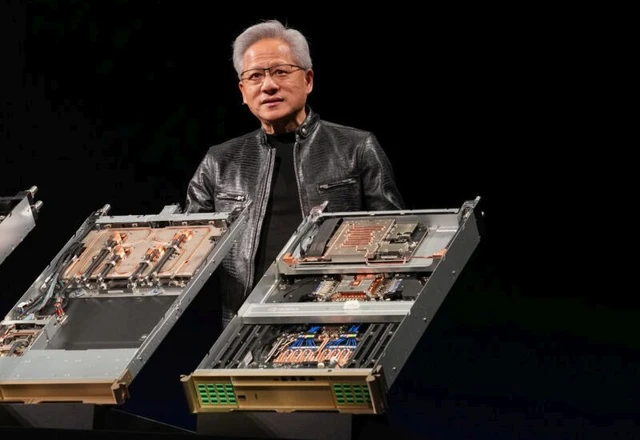
The global explosion of interest in artificial intelligence has fundamentally reshaped the semiconductor landscape. Fabless firms, prioritizing agile design over in-house manufacturing, are witnessing an unprecedented surge in valuation and capital growth. At the epicenter of this shift is Nvidia, whose lead over the competition is becoming nearly insurmountable. Yet, this redistribution of power extends beyond a single giant, fundamentally altering the established hierarchy of industry leaders.
The current technological epoch has been defined by the triumph of fabless semiconductor designers. The model—where a company focuses exclusively on architecture and intellectual property while delegating physical fabrication to foundry giants like TSMC—has proven exceptionally efficient amidst the AI gold rush. By the end of the second quarter, the aggregate revenue of the ten largest players in this segment surged by 73%, reaching a formidable $141.45 billion.
Nvidia remains the uncontested hegemon of the market. Its financial trajectory is nearly parabolic, with revenue nearly doubling to reach $91.2 billion. To grasp the scale of this dominance, one only needs to look at the company's share of the total revenue generated by the top ten fabless vendors: Nvidia accounts for 64% of the entire group's earnings. This transition elevates the company from a mere supplier of graphics accelerators to the central nexus of modern computing infrastructure.
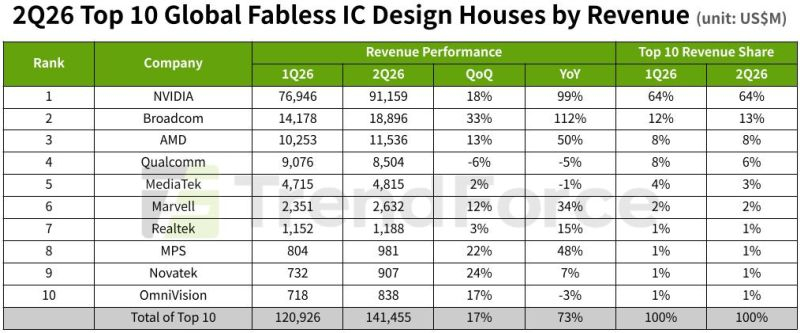
Broadcom has firmly secured second place, demonstrating the most striking growth trajectory of any participant in the rankings. A revenue increase of 112%, bringing the total to $18.9 billion, was made possible by a strategic pivot toward customization. Broadcom has evolved beyond the provision of off-the-shelf components to become a critical partner for giants like Google and OpenAI, developing specialized AI chips (ASICs). With six major clients currently engaged in this direction, the company is positioned for sustained growth in the near term.
Simultaneously, we are witnessing the rapid ascent of AMD, which has claimed third place on the podium. The company's revenue grew 1.5x, reaching $10.2 billion. This success is driven less by the GPU arms race and more by the dominance of its server-grade CPUs. As massive data centers are constructed to train neural networks, the demand for high-performance CPUs has become critical; AMD has effectively capitalized on this trend, systematically eroding Intel's market share. Revenue records in the server segment have been broken for five consecutive quarters, confirming a fundamental paradigm shift in server computing.
However, not every market participant has managed to capitalize on the current climate. Qualcomm, previously in third place, has receded to fourth. Its revenue declined by 5% to $8.5 billion, a direct consequence of an over-reliance on the smartphone market. The mobile device sector is currently navigating turbulent waters: shortages and the high cost of memory chips are exerting significant pressure on both margins and sales volumes.
A similar trend has affected MediaTek, which holds fifth place with revenue of $4.72 billion (a 1% decline). Despite the general downturn in the mobile segment, the Taiwanese firm is betting on adaptation; this year, the company expects to generate over $2 billion specifically from the implementation of AI solutions.
Rounding out the list of notable players are Marvell and Realtek. Marvell, in sixth place, showed steady growth of 34% (to $2.63 billion) thanks to its expansion into the server segment. Realtek, closing out the top seven with revenue of $1.15 billion, is also recalibrating its strategy, shifting its focus from consumer components toward server infrastructure solutions.
The overall market landscape points to a fundamental structural shift: the era of general-purpose computing is giving way to the era of specialized computation. While Nvidia and Broadcom define the trajectory of AI infrastructure, other players are forced to either carve out niches within the server segment or struggle to overcome the stagnation of the consumer electronics market.
 The Phenomenon of Chinese 96GB AI Accelerators