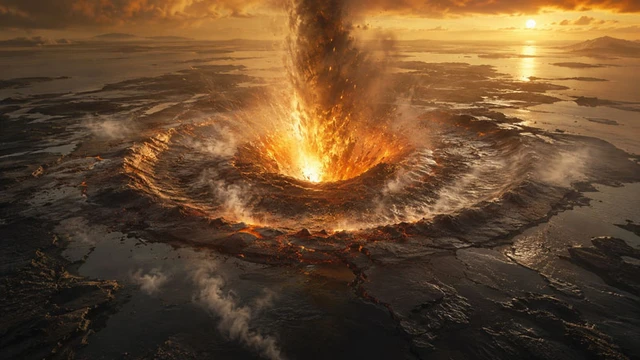
The Earth's surface behaves like a living organism, relentlessly scrubbing away the vestiges of its own history. Plate tectonics and erosion act as a colossal cosmic eraser, obliterating the evidence of primordial eras and ancient celestial impacts. Yet, a breakthrough discovery in Western Australia's Pilbara region has granted scientists a rare glimpse into the depths of the Archean eon. New data regarding the oldest known asteroid impact are reshaping our understanding of the planet's infancy and its volatile relationship with the cosmos.
Earth's geological record is inherently fragmentary. Unlike the Moon, which has preserved every crater as an immutable archive for eons, our planet possesses dynamic mechanisms of self-renewal. Geothermal processes, the relentless shift of lithospheric plates, and the ceaseless erosion of wind and water transform the ancient "scars" of cosmic collisions into dust or bury them deep within the mantle. Nevertheless, in the North Pole Dome region of Western Australia, researchers have uncovered a structure that challenges previous records.
For a long time, the title of the oldest documented impact belonged to the Maniitsoq region of Greenland, where a collision occurred approximately 3 billion years ago. The North Pole Dome site was previously estimated to be younger, dating back 2 to 2.5 billion years. However, a re-evaluation of the data using more precise analytical methods has recalibrated the timeline of this event to 3.024 billion years. Should this interpretation gain definitive scientific consensus, the site will become the only recognized Archean-age crater preserved in Earth's geology.
The primary evidence of the catastrophe lies in the presence of shatter cones. These distinctive fan-shaped structures are networks of fractures that form exclusively when an ultra-powerful shockwave rips through bedrock. Such formations are the hallmarks of collisions with massive cosmic bodies, serving as the asteroid's "fingerprints." Previously, researchers attempted to date the event through stratigraphy—the study of the relative positioning of rock layers. This approach yielded optimistic but contentious figures around 3.47 billion years, sparking extensive debate within the academic community.
To resolve these disputes, researchers shifted their focus from layer analysis to mineral composition. Zircon—one of the most resilient minerals on the planet—was selected as the "geological clock." Its uniqueness lies in its crystallization process: it actively absorbs uranium while almost entirely rejecting lead. Because uranium decays into lead over time, the ratio of these isotopes allows scientists to calculate the timing of an event with high precision. The energy of an asteroid impact effectively "resets" these clocks, freezing the moment of the catastrophe in time.
Of particular interest were zircon samples exhibiting a "skeletal" structure; these branching crystal forms indicate extreme heating and rapid recrystallization, characteristics typical of impact events. To verify the data, a second independent check was performed using apatite analysis. This phosphate mineral formed under the influence of hydrothermal fluids that seeped through the shattered rock following the impact. The fact that two different minerals, formed under entirely different conditions, converged on the same date—approximately 3.02 billion years—renders the conclusion regarding the crater's true age virtually indisputable.
The significance of this discovery extends far beyond simply updating a record. The North Pole Dome serves as a rare window into an era when Earth was first assuming its modern form and the first continental nuclei were coalescing. Understanding the frequency and scale of such impacts during the Archean Eon provides critical insights into how cosmic bombardment influenced the chemical composition of the surface and, potentially, the emergence of the first forms of life.
 The Evolution of Solid-State Batteries: From Smartphones to Electric Vehicles