The AI revolution is fundamentally reshaping the semiconductor landscape. An insatiable demand for high-performance computing is pushing foundries to their absolute limits, igniting a new chapter in the global technological arms race. While TSMC maintains a near-total monopoly, a significant shift in power is underway among the second tier of industry players. Current market dynamics reveal a profound divergence between cutting-edge process nodes and mature lithography.
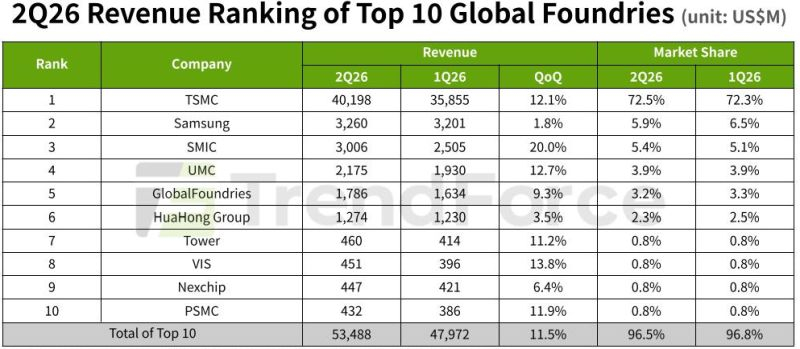
The AI explosion has triggered an exponential surge in demand for specialized semiconductor components. Since the vast majority of these solutions are delivered via the foundry model, the financial performance of the industry's leading players is showing robust growth. In the last quarter, the aggregate revenue of the top ten manufacturers climbed by 11.5%, reaching $53.49 billion.
At the heart of this ecosystem remains TSMC, whose market dominance continues to solidify. The company has expanded its share to 72.5%, with quarterly revenue rising 12.1% to $40.2 billion. Notably, production capacities for 5nm, 4nm, and 3nm process nodes are now fully booked. Furthermore, the financial reports reveal the first instances of revenue generated from 2nm technology. This signals deep preparation for the next consumer electronics refresh cycle, including the upcoming launch of Apple's iPhone 18 family, which traditionally serves as the catalyst for the adoption of the most advanced lithographic nodes.
A compelling phenomenon of the current period is the paradox of memory chip shortages. Conventionally, a shortage of memory should have throttled the production of laptops and smartphones, thereby dampening demand for primary processors. In practice, however, the opposite occurred: device manufacturers began stockpiling components en masse, fearing further price hikes. This "buffer stock" effect has bolstered pricing even within the legacy node segment, where the technology stack is considered mature. The autumn season typically brings a spike in consumer gadget sales, while the AI infrastructure segment will continue to expand driven by the shipment of previously announced solutions.
Against the backdrop of TSMC's triumph, Samsung is experiencing a concerning trend. Despite a nominal 1.8% increase in foundry revenue (to $3.26 billion), the company is effectively losing ground, with its market share slipping from 6.5% to 5.9%. This void is being rapidly filled by China's SMIC. Demonstrating aggressive growth with a 20% revenue increase (to $3 billion), SMIC has pushed its share to 5.4%, nearly closing the gap with Samsung.
The second tier of manufacturers is also showing mixed performance. Taiwan's UMC remains stable, holding fourth place with a 3.9% share and $2.2 billion in revenue. The US-based GlobalFoundries, occupying fifth place, managed to increase revenue by 9.3% to $1.8 billion, despite a slight dip in market share to 3.2%. This reinforces the thesis that even second-tier players are currently capable of delivering double-digit revenue growth amid the general market upswing.
Rounding out the leaders are China's Huahong Group and a cluster of Taiwanese manufacturers. Huahong, in sixth place, posted more modest revenue growth of 3.5% (to $1.27 billion) and a slight decline in market share to 2.3%. The remaining members of the top ten split the remaining shares, recording revenues of approximately 0.8% per player.
The overall market landscape points to an extreme concentration of capital and capacity. The ten largest companies account for 96.5% of total global foundry revenue. Although this figure has dipped slightly from the previous period (from 96.8%), market consolidation remains overwhelming, leaving minimal room for maneuver for smaller players outside this exclusive circle.
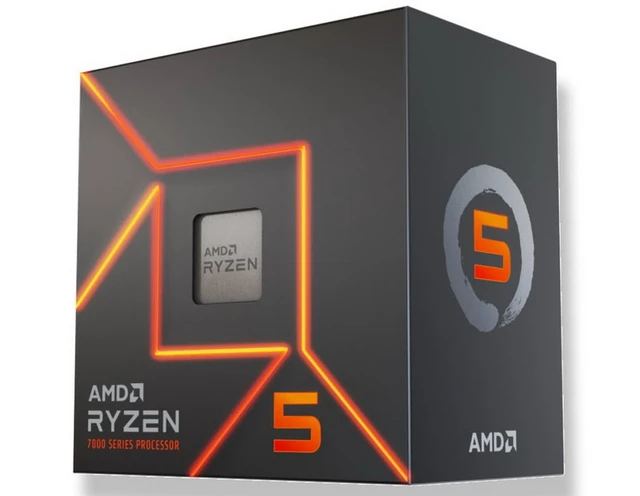 AMD’s Strategic Approach to the Budget Segment