Today's CPU market is defined by a delicate balancing act between raw, extreme performance and economic viability. AMD continues to meticulously refine its portfolio, strategically filling gaps across both current-generation and legacy platforms. The introduction of new Ryzen 5 models for the AM4 and AM5 sockets underscores the company's commitment to maintaining dominance in the budget segment. This approach provides users with a clear choice: breathe new life into aging hardware or enter the modern ecosystem with maximum cost-efficiency.
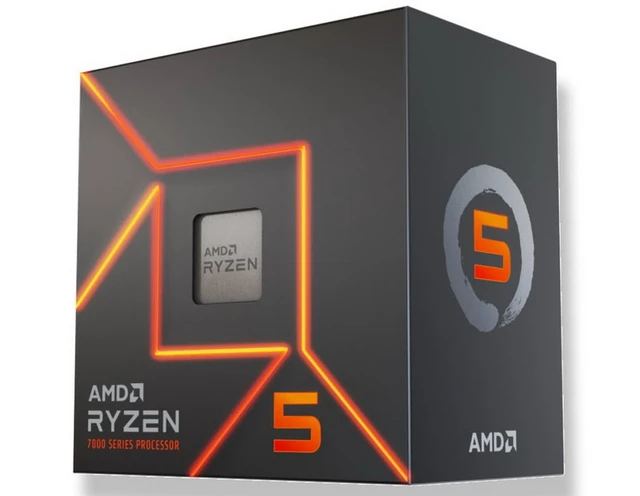
AMD is diversifying its processor lineup across two fronts simultaneously, reflecting a pragmatic strategy regarding its product lifecycles. The company has introduced two new six-core solutions: the Ryzen 5 7500, tailored for the modern AM5 platform, and the Ryzen 5 5500F, designed for the time-tested AM4.
Within the current generation of Zen 4-based systems, the Ryzen 5 7500 stands as the key update. Technically, it is nearly indistinguishable from the popular Ryzen 5 7500F, featuring 6 cores and 12 threads with a base clock of 3.7 GHz and a boost clock reaching 5.0 GHz. The power profile remains unchanged, with a TDP of 65W and a total cache capacity of 38 MB (6 MB L2 and 32 MB L3).
The primary differentiator and value proposition of the 7500 model is the inclusion of integrated graphics. Unlike the "F" variant, this processor is equipped with a streamlined RDNA 2 graphics core featuring two compute units operating at frequencies up to 2.2 GHz. While this integrated GPU is not intended for demanding gaming, it is indispensable for system diagnostics, office productivity, and assembling a PC without a discrete graphics card during the initial setup phase.
Parallel to this, AMD continues to sustain the AM4 platform, which remains highly sought-after due to its accessibility. The new Ryzen 5 5500F presents a compelling technical case; it is not merely a cosmetic rebranding of the existing Ryzen 5 5500, but a fundamentally different silicon implementation.
While the standard Ryzen 5 5500 utilizes the Cezanne die (essentially an APU with disabled graphics), the 5500F is built upon a full-fledged Vermeer desktop die. However, there is a critical nuance: the L3 cache is limited to 16 MB, half that of its higher-tier sibling, the Ryzen 5 5600. The new chip's clock speeds range from 3.0 to 4.4 GHz within a standard 65W thermal envelope. This configuration establishes a clear segmentation within the lineup, offering the most budget-friendly entry point into the Zen 3 ecosystem.
Official launch timelines and global pricing have yet to be formally disclosed by AMD, which often suggests a focus on the OEM market or specific regional territories. Nevertheless, retail data provides insight into the pricing landscape: the Ryzen 5 5500F is estimated at approximately $119, while the more modern Ryzen 5 7500 is positioned around $227.
This strategic expansion of the portfolio allows AMD to compete effectively across various price brackets, offering flexible upgrade paths for users with differing budgets without compromising fundamental multi-threaded performance.
 A Comprehensive Refresh of Apple's Global Product Portfolio