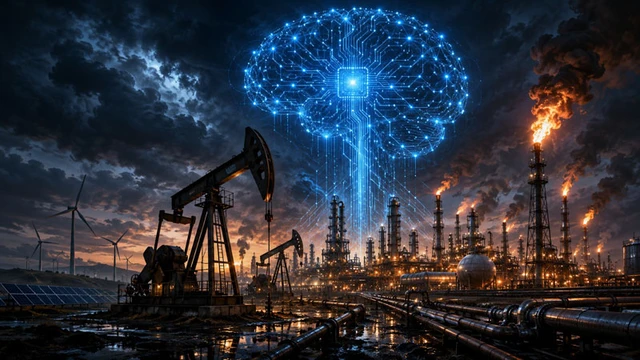
For years, the environmental footprint of artificial intelligence has been analyzed almost exclusively through the prism of data center energy consumption. Yet, a more rigorous analysis reveals a far more systemic and perilous impact: these algorithms are actively stimulating the extraction of hydrocarbons. Paradoxically, technological leaps in this field are accelerating the exploitation of fossil fuels at a pace that outstrips the growth of green energy generation. Consequently, rather than serving as a catalyst for climate rescue, AI is emerging as a powerful lever that reinforces the legacy energy paradigm.
Contemporary discourse on ecology and high technology often centers on optimizing renewable energy sources. However, recent research utilizing global general equilibrium models reveals a hidden mechanism: AI is acting as a powerful catalyst for the oil and gas sector. When algorithms are deployed simultaneously across both traditional and "green" energy, the net balance proves negative. Projected global emissions are expected to rise by 0.47 to 1.8 billion tons of CO2 annually—equivalent to nearly 5% of all global energy emissions in 2024.
This effect is driven by a fundamental economic imbalance. Gains in oil and gas extraction efficiency yield far more pronounced financial returns than equivalent productivity increases in solar or wind farms. In this context, artificial intelligence functions as a high-precision instrument: it analyzes complex geological data, minimizes drilling risks, and optimizes well maintenance in real time. Ultimately, this radically lowers production costs, transforming previously inaccessible or economically unviable deposits into profitable assets.
The scale of this impact is staggering. According to analysts at Wood Mackenzie, the volume of additional resources that could become accessible thanks to AI is measured in hundreds of billions, and potentially even a trillion, barrels of oil. In the shale sector, algorithms can increase recoverable reserves by 20% and slash drilling costs by nearly a third. Industry statistics confirm the velocity of this shift: nearly half of the world's oil and gas companies have already integrated AI into their exploration processes, with the remainder planning to do so within the next three years.
The paradox is that green energy also derives significant benefits from digitalization. Algorithms allow for surgical precision in forecasting solar and wind activity, optimizing smart grid operations, and managing storage charge cycles. In some scenarios, productivity growth in renewables reaches 30%, which could potentially prevent up to 500 million tons of CO2 emissions per year.
However, this is insufficient to offset the "dark side" of progress. Calculations reveal a harsh proportion: to neutralize just a 1% increase in oil and gas efficiency, renewable energy productivity must grow by 4–5%. Furthermore, AI is powerless against physical and bureaucratic bottlenecks. Algorithms cannot build new transmission lines, shorten grid connection queues, or accelerate the permitting processes that remain the primary drag on renewable development.
Within this framework, the concept of AI's "carbon footprint" requires a fundamental rethink. The direct electricity costs of running servers are secondary compared to the hidden emissions enabled by the optimization of fossil fuel extraction. These indirect emissions could exceed the energy consumption of all the world's data centers tenfold.
Consequently, without stringent regulation and the implementation of carbon pricing mechanisms, artificial intelligence risks becoming a tool for entrenching the legacy energy system. Rather than accelerating the energy transition, the technology is making oil and gas cheaper and more accessible, propagating this effect across the global economy—from heavy industry to petrochemicals. Intelligent systems designed to optimize the world are, under current market conditions, working to strengthen humanity's dependence on hydrocarbons.
 Anthropic’s Strategic Push for Hardware Independence