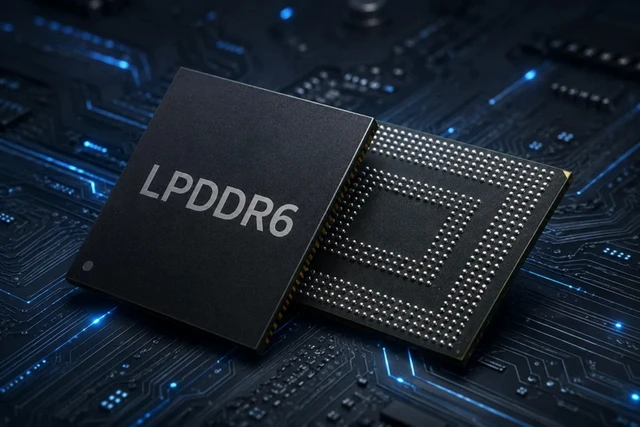
The global semiconductor market is undergoing a profound transformation, where the pursuit of data transfer speeds has become the definitive metric of competitiveness. While industry titans pivot toward specialized AI-driven solutions, a strategic vacuum is opening in the standard high-speed memory segment. China’s ChangXin Memory Technologies (CXMT) intends to seize this opportunity, aggressively accelerating the development of its next-generation silicon. The transition to the LPDDR6 standard represents CXMT's bid to break beyond domestic boundaries and challenge the entrenched oligopoly of global DRAM manufacturers.
The contemporary memory industry is on the precipice of a paradigm shift. CXMT has already pivoted to aggressive testing of LPDDR6 chips, initiating the preparation of production chains well ahead of the official commercial rollout of full-scale DDR6. This preemptive strategic move signals the company's ambition not merely to follow market trends, but to actively shape the supply infrastructure for years to come.
A pivotal element of this technological leap is a radical overhaul of chip packaging methodologies. For DDR6, traditional roll-to-roll processing has become economically and technically untenable due to increased requirements for substrate layer counts and positioning precision. In response, CXMT is transitioning to panel-level packaging (PLP), enabling the creation of complex multi-layer architectures with significantly higher cost-efficiency and throughput during mass production. To execute this strategy, the company has partnered with Haesung DS as a key substrate supplier, laying the groundwork for industrial scaling.
The technical specifications of the new LPDDR6 chips are impressive, with data transfer rates reaching 12.8 Gbps. These metrics place CXMT’s advancements on par with flagship products from Samsung and SK Hynix, effectively closing the performance gap between the Chinese contender and the global incumbents. Mass production is expected to commence in the second half of 2026, although full-scale integration of the DDR6 standard into consumer electronics is anticipated later—likely around 2028–2029.
Currently, CXMT ranks fourth globally among DRAM manufacturers with a market share of approximately 7.7–8%. The production capacity of its Hefei plant allows for an output of roughly 300,000 wafers per month, providing a formidable foundation for expansion. However, CXMT's true growth potential lies in the current resource allocation of its competitors. Samsung and SK Hynix are currently heavily pivoted toward High Bandwidth Memory (HBM) to meet the demands of neural networks, which inevitably leads to a diversion of resources and diminished focus on the traditional LPDDR segment.
This market climate creates a strategic window of opportunity for CXMT. The company is already deeply embedded in the ecosystems of major Chinese brands such as Huawei, Xiaomi, and Oppo, while also supporting the infrastructural needs of cloud giants Alibaba Cloud and Tencent Cloud. Perhaps the most significant growth vector, however, remains a potential entry into the global market via Apple certification. Should CXMT's chips pass these rigorous tests, it would serve as the definitive validation of the company's technological maturity and its ability to compete at the highest echelon of quality.
 Nvidia N1X and the New Era of Arm PCs