The meteoric rise of generative AI has pushed the semiconductor industry to the brink of a severe resource crisis. Today, available memory capacity has emerged as the primary bottleneck for technological advancement, dictating the trajectory of both neural network evolution and cloud computing scalability. Recent market analysis suggests that this supply-demand imbalance is poised to intensify through the end of the decade, leaving the global economy vulnerable to a systemic component shortage that could ripple across every layer of our digital infrastructure.
The modern digital economy is entering a phase of acute scarcity regarding data storage and processing resources. According to the latest data from Citrini Research, the global memory chip market will remain in a state of permanent deficit until at least 2030. Even with the massive expansion of production capacities in China, the growth rate of DRAM demand is significantly outpacing the industry's ability to manufacture new components.
The scale of the crisis is staggering: by 2030, the projected deficit could reach 28.7 exabytes against a total global demand of 157.5 exabytes. In essence, the market will lack a quarter of its required memory capacity. Meanwhile, the critical pressure point is shifting toward general-purpose DRAM—this segment remains the primary bottleneck, despite the rapid evolution of High Bandwidth Memory (HBM), which currently serves as the foundation for training Large Language Models (LLMs). For comparison, the current deficit is estimated at approximately 18%, signaling a steady deterioration of the situation.
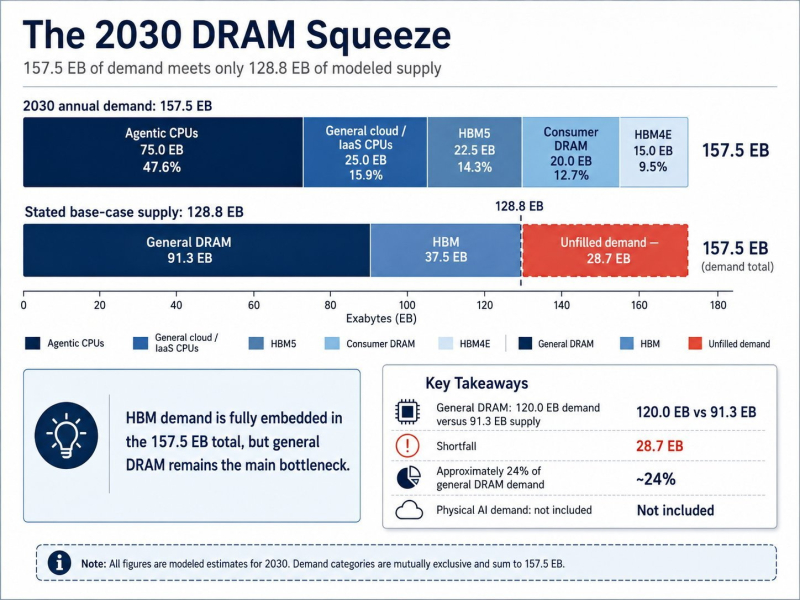
Of particular interest is the fact that these forecasts are conservative. They do not account for demand from so-called "Physical AI"—autonomous robots and self-driving vehicles—which will require colossal amounts of memory to process sensory data in real time. Consequently, even if current estimates for data center requirements prove overblown, any surplus will be instantaneously absorbed by the expansion of intelligent machines into the physical world.
The dynamics of production capacity are alarming. This year, global DRAM output stands at approximately 40 exabytes, which is nearly equivalent to the projected deficit by the end of the decade. By 2030, the industry is expected to supply only 91 exabytes per year against a real requirement of 120 exabytes. Such a disparity will inevitably sustain high prices; the cost per gigabyte of DRAM is likely to stabilize between $1.5 and $2, exerting additional financial strain on technology companies.
Software innovation is being viewed as a potential lifeline. Algorithmic optimization could significantly lower hardware requirements. A prime example is Google's TurboQuant, which promises a sixfold reduction in memory consumption for AI models through more efficient data quantization. However, this introduces a classic efficiency paradox: any reduction in cost or resource volume often leads not to savings, but to even wider adoption of the technology. It is highly probable that increased algorithmic efficiency will only whet the industry's appetite, triggering a new wave of demand and further exacerbating the shortage of physical components.

 The Horizon of China's Technological Sovereignty in Lithography