The contemporary race for orbital access is pivoting toward maximum operational agility and deployment flexibility. Chinese aerospace firm Orienspace is defying conventional paradigms regarding the capabilities of solid-propellant systems by engineering launch vehicles of unprecedented scale. The successful third mission of the Gravity-1 rocket validates the efficacy of maritime launch strategies combined with high payload capacity—a strategic milestone that paves the way for the next generation of global satellite constellations.
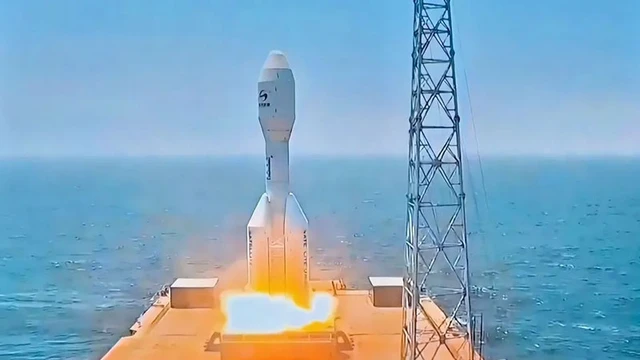
The third launch of the Gravity-1 launch vehicle marks a pivotal milestone for China's private aerospace sector. Executed from a converted sea-based platform in the East China Sea, the mission demonstrated high-precision deployment of nine satellites and experimental modules into their target orbits. The utilization of maritime platforms is more than a technical convenience; it is a strategic maneuver. By shifting the launch site to the open ocean, operators can optimize flight trajectories and select any orbital inclination while minimizing risks to populated areas and eliminating the need for large-scale airspace closures.
Technically, the Gravity-1 diverges sharply from the conventional "slender" rocket aesthetic. Standing approximately 30 meters tall with a liftoff mass of 405 tonnes, the vehicle possesses a squat, massive silhouette. Its propulsion system is entirely solid-propellant based: three central stages augmented by four powerful side boosters. This configuration delivers impressive lift capacity—up to 6.5 tonnes for Low Earth Orbit (LEO) and 4.2 tonnes for a Sun-Synchronous Orbit (SSO) at an altitude of 500 km. The payload, housed beneath a 4.2-meter diameter fairing, represents a sophisticated technological stack.
This mission successfully deployed a series of Dongpo remote sensing satellites. Four of these are equipped with Synthetic Aperture Radar (SAR), capable of penetrating cloud cover and darkness, while two others utilize high-precision optical cameras. These instruments are critical for monitoring natural resources, managing agriculture, and ensuring rapid response during natural disasters.
Beyond the primary fleet, the mission included several ambitious experiments. The 50 kg Tianyi-49 (BUPT-4) satellite and the Xiguang-2-01 hyperspectral spacecraft highlight the growing trend toward "intelligent space." The latter is equipped with on-board artificial intelligence for real-time image processing, significantly reducing data transmission latency to Earth. Rounding out the manifest is Lilac-3, a prototype ultra-thin spacecraft designed to test the absolute limits of satellite system miniaturization.
The success of three consecutive Gravity-1 missions lays the groundwork for the next ambitious phase: the deployment of a national LEO satellite internet constellation. However, Orienspace is not resting on its laurels. The Gravity-2 is already under development, marking a transition to a hybrid configuration featuring a liquid-propellant central stage. This leap is expected to increase payload capacity to 21.5 tonnes for LEO, effectively propelling the company into the elite league of heavy-lift space systems.
 The Triumph of 3nm Chip Manufacturing