The global space industry is undergoing a fundamental paradigm shift toward full reusability—a capability that, for years, remained the exclusive purview of a handful of private American firms. The successful test of the CZ-10B launch vehicle marks a tectonic shift in the balance of power, propelling China into the elite circle of nations capable of recovering orbital stages. This milestone has transcended the realm of mere technical experimentation, serving as a strategic signal of Beijing's ambition to dominate Low Earth Orbit (LEO). Consequently, the cost of access to space is plummeting, and the trajectory to the Moon is becoming significantly shorter.
A watershed moment arrived with the maiden flight of the 70-meter behemoth, the CZ-10B (Long March 10B), launched from the Wenchang Spacecraft Launch Site. This two-stage, medium-lift rocket—designed as a monoblock without side boosters—represents the pinnacle of contemporary Chinese aerospace engineering. With a liftoff mass of 760 tons and a fuselage diameter of 5 meters, the vehicle is capable of delivering up to 16 tons of payload to Low Earth Orbit (LEO), positioning it as the ideal instrument for deploying massive satellite internet constellations.
The technical sophistication of the first stage is powered by seven YF-100 liquid-propellant rocket engines running on a LOX/kerosene propellant pair. The implementation of a staged combustion cycle (closed cycle with oxidizer-rich pre-burner) has enabled a high specific impulse, which is critical for liftoff efficiency. While the total thrust, ranging from 890 to 1,000 tons-force, ensures a commanding ascent, the true breakthrough lies in its deep throttling capabilities. This ability to flexibly modulate thrust allowed for the execution of complex braking maneuvers—specifically the Boostback and Landing burns—without which a precise atmospheric reentry would have been impossible.
The second stage employs an even more forward-looking solution: the YF-219 oxygen-methane engine. The transition to methalox is driven by the requirements of reusability; unlike kerosene, methane does not cause coking (the buildup of soot) within the cooling channels. This radically simplifies engine maintenance between flights and extends the overall system's operational lifespan. Generating 140 tons-force in a vacuum, this engine provides the surgical precision required for orbital insertion.
Following a nominal stage separation, the first stage executed a complex return maneuver, culminating in an impeccable landing on the Linghangzhe sea platform in the South China Sea, 430 kilometers from the launch site. It is here that Chinese engineers diverged from the SpaceX playbook.
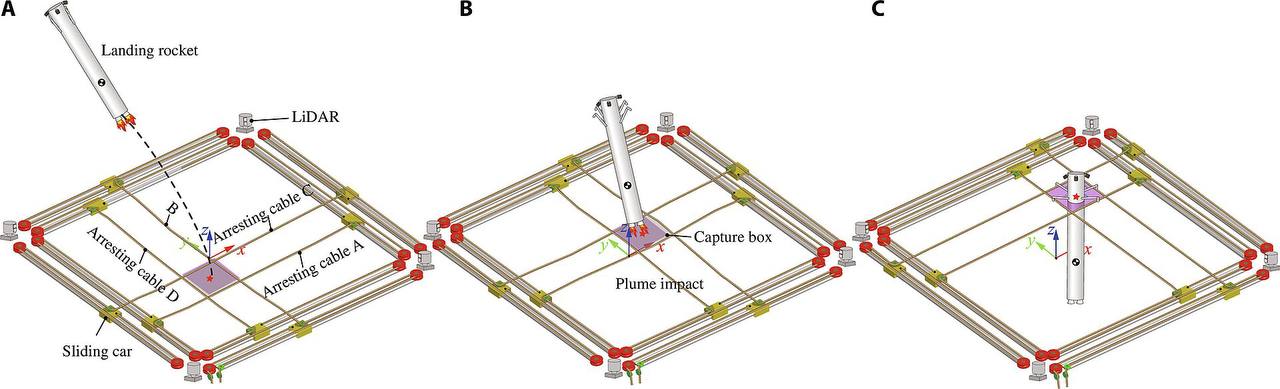
Rather than utilizing heavy deployable landing legs—which increase the rocket's dry mass and cannibalize payload capacity—they implemented an innovative net-capture system. The upper section of the stage is equipped with specialized high-strength rods and hooks, while the Linghangzhe platform features a sophisticated truss system with a tensioned net and cable array. As the stage reaches its final hover, it enters the trap's aperture, and the net absorbs the remaining kinetic energy, securing the rocket in mid-air. This engineering trade-off allows for a significantly lighter structure, directly increasing the mass of the payload delivered to orbit.
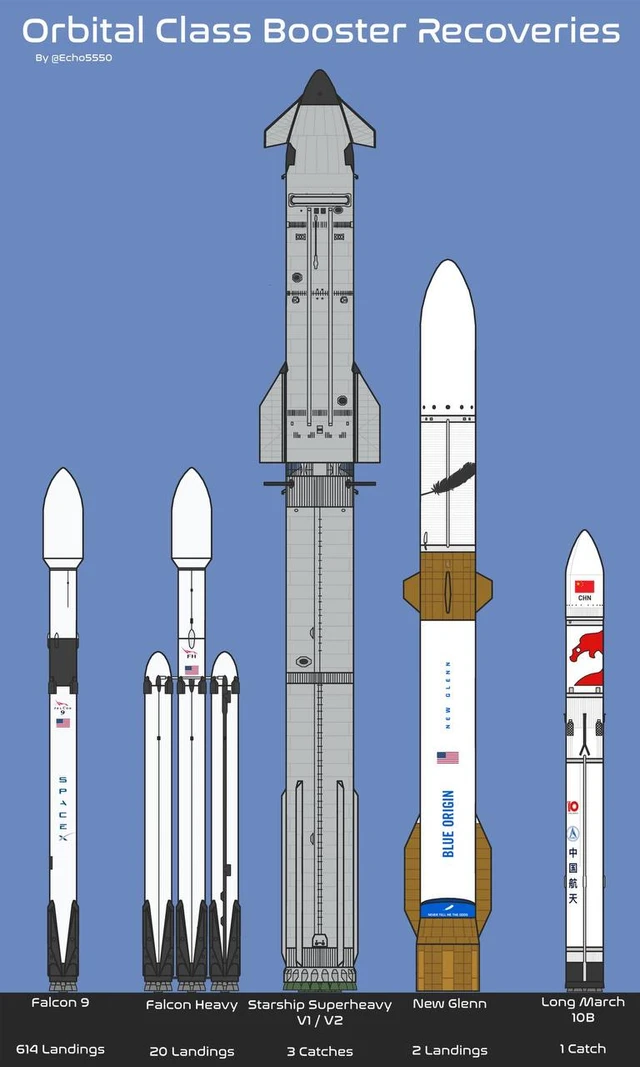
Until now, the art of returning orbital stages was considered nearly the exclusive domain of SpaceX and Blue Origin. The fact that the China Academy of Launch Vehicle Technology (CALT) achieved this result on its first attempt speaks to an immense amount of preparatory work and computational precision. While other Chinese agencies and private startups have faced setbacks at various testing phases, CALT has demonstrated 100% efficiency.
The recovered stage is currently undergoing detailed post-flight analysis. If its structural integrity is confirmed, plans are in place to fly it again before the end of the year, which would officially usher in the era of mass-market, low-cost launches in the PRC.
However, the CZ-10B is more than just a transport vehicle; it is a comprehensive technological testbed. All developments in reusability and propulsion will form the foundation of the super-heavy crewed Long March 10 system. This rocket is designed to deliver taikonauts to the Moon by 2030. The first stage of the CZ-10B is effectively identical to the core block of the future lunar system, where 21 YF-100K engines will operate in synchronous mode.
Beijing's success today intensifies the lunar race with the United States. NASA has openly acknowledged that the competition has become exceptionally fierce, with the gap in program implementation schedules now measured in months. The goal for both superpowers is not merely a brief landing, but the establishment of permanent bases at the resource-rich Lunar South Pole. In this race, reusable systems have become the ultimate trump card, determining who will first secure a foothold on the Earth's satellite by the end of the decade.
 Starship's Return from the Indian Ocean