The global race for network dominance has reached an unprecedented new frontier. SpaceX is pivoting from the mere provision of internet connectivity toward the construction of a planetary data infrastructure of colossal proportions. The proposal to deploy 100,000 third-generation satellites signals a fundamental paradigm shift in the conceptualization of orbital networks. This is no longer simply about bridging the digital divide; it is about forging the technological bedrock for an era of ubiquitous artificial intelligence.
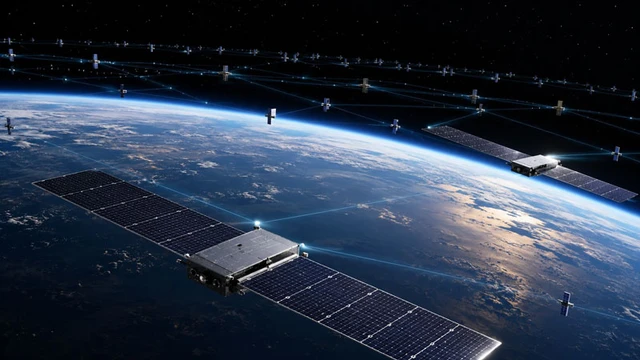
SpaceX's vision for the transformation of near-Earth space has entered a phase of radical escalation. The company has submitted a request to the U.S. Federal Communications Commission (FCC) to deploy a third-generation constellation comprising 100,000 satellites. While current Gen2 limits restrict the network to approximately 15,000 spacecraft, this new blueprint proposes a tenfold increase, effectively turning low Earth orbit into a dense shell of high-tech infrastructure.
The technical specifications of the Gen3 hardware signal a shift toward fundamentally greater capabilities. Each new satellite will be three times heavier than its predecessors, reaching a mass of 2–2.5 tons, with deployed solar arrays spanning between 300 and 400 square meters. For comparison, the current V2 Mini models weigh roughly 800 kg and occupy a third of the space. Such a significant increase in scale and mass renders the Falcon 9 impractical; the realization of this project is now directly contingent upon the full operational deployment of Starship, which is designed to deliver multi-ton payloads to orbit at an industrial scale.
The orbital architecture has also evolved. SpaceX intends to utilize Very Low Earth Orbits (VLEO) within two precise altitude shells: 323 to 327.5 km and 473 to 477.5 km. With inclinations ranging from 26° to 96.9°, this configuration will ensure that users have simultaneous visibility of multiple satellites, allowing for efficient traffic distribution and minimized signal latency.
The primary catalyst for this expansion is the proliferation of artificial intelligence. Modern AI systems, autonomous transport, and industrial automation generate staggering volumes of sensor data, video streams, and telemetry that require near-instantaneous transmission to cloud processing centers. To meet this demand, Gen3 will offer symmetric multi-gigabit throughput for both uplink and downlink.
To achieve these speeds, SpaceX is implementing a cutting-edge technological stack: active electronically scanned arrays (AESA) for beam steering, advanced digital signal processing, and inter-satellite optical links. Beyond the standard Ku, Ka, V, and E bands, the company aims to utilize the W and D bands (92 to 275 GHz). These ultra-high frequencies are critical for expanding the backbone channels between the space segment and ground stations, effectively transforming the network into a "celestial data pipeline."
However, such massive expansion comes with a significant trade-off. The sharp increase in the number and surface area of reflective objects in orbit will inevitably intensify light pollution in the night sky, posing serious challenges for ground-based astronomy.
In the long term, Starlink Gen3 appears to be merely a transitional phase. The company's trajectory suggests an ultimate goal of creating a comprehensive orbital compute fabric—deploying millions of AI servers directly in space. This would evolve the satellite constellation from a simple signal relay into a planetary-scale distributed supercomputer.
 Starship's Return from the Indian Ocean