Humanity's energy transition has long been constrained by the inherent physical limitations of conventional lithium-ion systems. For years, solid-state batteries have remained the industry's "holy grail," promising a quantum leap in energy density and uncompromising safety. Today, ProLogium is transitioning these breakthroughs from the sterile confines of the laboratory to the reality of industrial-scale production. The launch of mass production for its Generation 3.5 cells marks the dawn of a new era in global energy storage.
The transition from prototyping to the mass production of third-generation (3.5) solid-state lithium-ceramic batteries (LCB) marks a pivotal moment for the industry, signaling that the critical gap between theoretical efficiency and real-world application has finally been bridged. High energy density is no longer merely a laboratory achievement; it is becoming a scalable industrial standard.
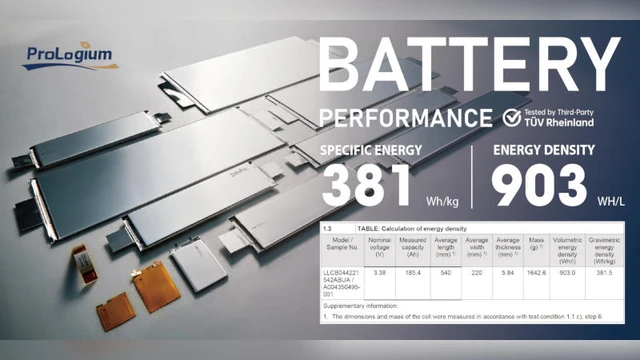
The performance metrics of these new cells are compelling. Independent testing by TÜV has confirmed that a large-format cell with a capacity of 185.4 Ah achieves a gravimetric energy density of 381 Wh/kg and a volumetric density of 903 Wh/L. In practical terms, this means batteries have become lighter and more compact without sacrificing energy capacity, all while delivering high power output and supporting ultra-fast charging protocols.
Particular emphasis has been placed on safety and the fundamental material composition of the cells. Testing by UL Solutions, conducted under the rigorous GB/T 43568-2026 standard, has validated the device's status as "fully solid-state." Even after six hours in a vacuum at 120°C, the cell's mass loss was less than 0.05%—ten times lower than the permissible threshold. This demonstrates exceptional material stability and the total absence of the volatile organic compounds that render traditional batteries combustible.
At the heart of this technological breakthrough is the Logithium concept. Architecturally, it consists of a ceramic separator positioned between the electrodes, encased by a specialized protective frame. This component serves multiple critical functions: it prevents adjacent layers from being damaged by micro-protrusions (burrs) on the electrode edges, ensures a hermetic seal, and guarantees electrical insulation.
This modular architecture allows ProLogium to flexibly iterate on chemical compositions and electrode materials without overhauling its production lines. This creates a foundation for rapid product evolution without the prohibitive costs typically associated with equipment modernization.
Looking ahead, the company is planning the transition to fourth-generation batteries. The primary evolution will be the complete elimination of organic materials. Preliminary estimates suggest that implementing this technology will require modifying only about 10% of existing equipment. The next generation promises not only further gains in energy density and charging speeds but also the introduction of an Anti-Short-circuit Mechanism (ASM)—a critical protection system for operation under extreme temperature conditions.
Beyond technical specifications, the fourth generation is designed to be more cost-competitive through material optimization and streamlined manufacturing processes. This will broaden the application of solid-state cells, extending their reach from electric vehicles to the energy storage systems powering AI data centers, as well as specialized solutions for the maritime and aerospace sectors.
To realize these ambitions, ProLogium is establishing a global production ecosystem. Taiwan will remain the innovation epicenter, focusing on R&D and process optimization. Primary mass-production capacities are slated for deployment in France, while North America will host regional production and logistics hubs. Moving forward, this expansion model will be scaled across the entire Asia-Pacific region.
 The High-NA EUV Technological Leap