The contemporary consumer electronics market is driving toward the democratization of large-scale displays, transitioning oversized panels from luxury status symbols into an accessible standard. Yet, beneath the allure of an attractive price point, critical compromises in image fidelity and hardware performance often lurk. The arrival of the Hyundai H-LED65BU7011 prompts a critical examination of the actual ceiling for the budget segment. Analyzing this device allows us to pinpoint exactly where the line is drawn between aggressive cost-cutting and the preservation of fundamental quality.
Hyundai has long carved out a niche in the affordable segment, building a reputation as a manufacturer that knows how to strike a precise balance between cost and utility. The H-LED65BU7011 continues this strategy, offering a 65-inch 4K panel at a price point typically associated with much smaller screen sizes. Despite the skepticism often triggered by the combination of a massive display and a low price tag, the device demonstrates surprising stability, devoid of the critical flaws frequently found in similar budget-tier products.
Aesthetically, the television is a classic utilitarian piece of hardware—a stark black rectangle. The designers have worked to minimize the bezels to enhance the immersive experience, and they have succeeded: the narrow borders do not distract from the content, and the bottom chin of the panel avoids looking excessive. With a thickness of 64 mm, the unit is well-suited for wall mounting via the VESA 200×200 standard, although its weight of 14.6 kg demands a sturdy installation approach. The build quality is commendable: metal legs ensure stability, and the interface layout is thoughtfully designed so that cables do not bend at acute angles when the unit is mounted flush against a wall.
The port selection is impressively comprehensive: four HDMI 2.1 interfaces, two USB ports, an S/PDIF optical output, CI+, and a full-fledged Ethernet port. The power supply is routed separately, allowing for flexible cable management.
Under the hood, the device is powered by a quad-core ARM Cortex-A55 clocked at 1.5 GHz, paired with an ARM Mali-G52 MP2 graphics accelerator. Despite a modest 2 GB of RAM, the system is surprisingly responsive. This is the result of high-quality optimization of Google TV running on Android 14. The interface reacts instantaneously; navigating menus and launching apps from the Play Store occurs without noticeable lag—a common pain point even for more expensive models. The 16 GB of internal storage is sufficient for an essential suite of applications, and support for a wide array of codecs (including AV1 and HEVC) transforms the device into a versatile media center.
The display's technical specifications feature a VA matrix with Direct LED backlighting. The choice of a VA panel ensures deep blacks and high static contrast, which measures 3946:1, while dynamic contrast can climb as high as 6000:1. The panel's brightness stands at 312 cd/m², which is adequate for comfortable viewing in daylight, although the image's true visual potential is unlocked in a darkened room.
A noteworthy point is the handling of the refresh rate. While the native refresh rate of the matrix is 60 Hz, the device implements DLG 120 Hz technology. This works on the principle of software-based frame doubling via line skipping, which effectively reduces the resolution to Full HD. This mode is best reserved exclusively for fast-paced gaming, leaving cinematic content in native 4K.
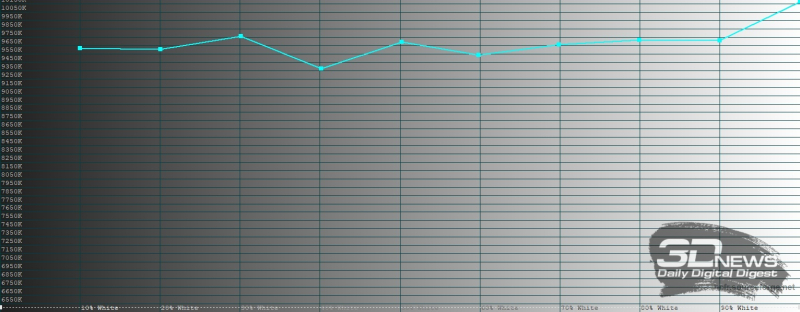
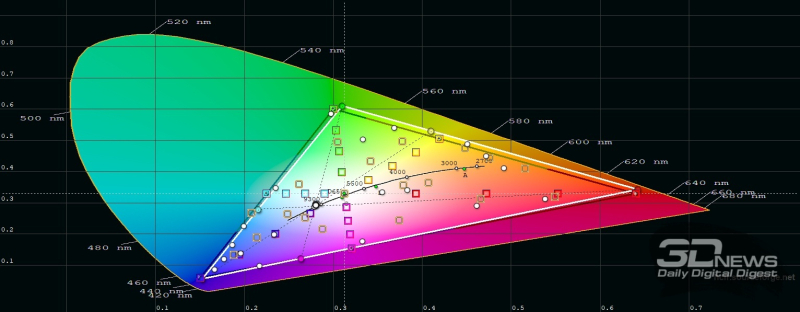
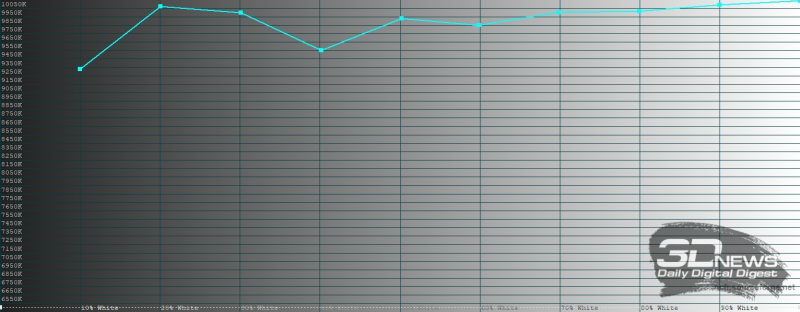
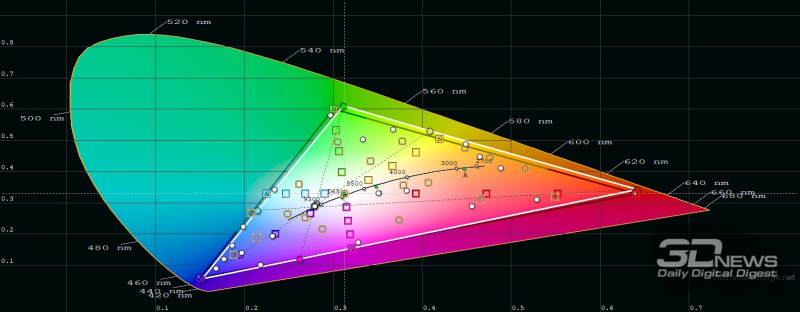
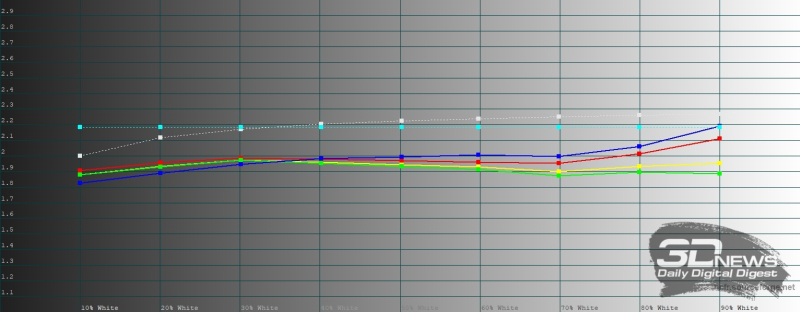
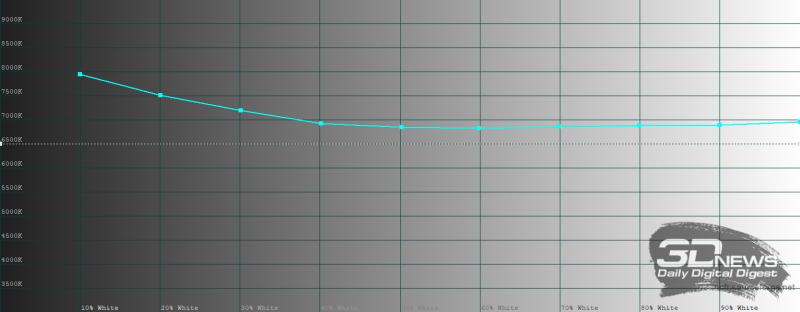
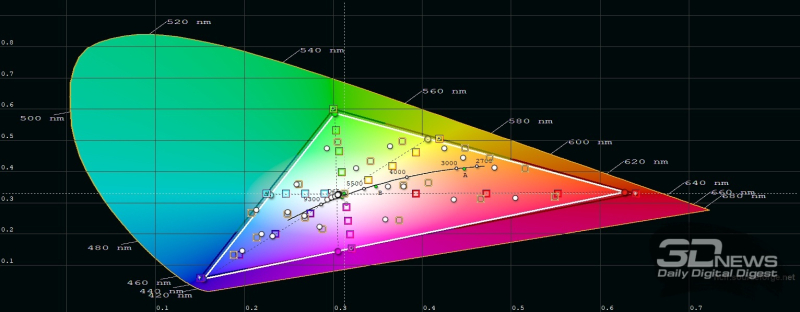
Color accuracy analysis reveals some inconsistency in the factory settings. In both Energy Saving and Standard modes, the image has a pronounced cool cast: the color temperature rises to 9,350–10,000 K against a reference of 6,500 K. The average DeltaE deviation in these modes is approximately 7.93–9.95, indicating noticeable color distortion. The color gamut remains close to the sRGB standard, offering no expanded palette.
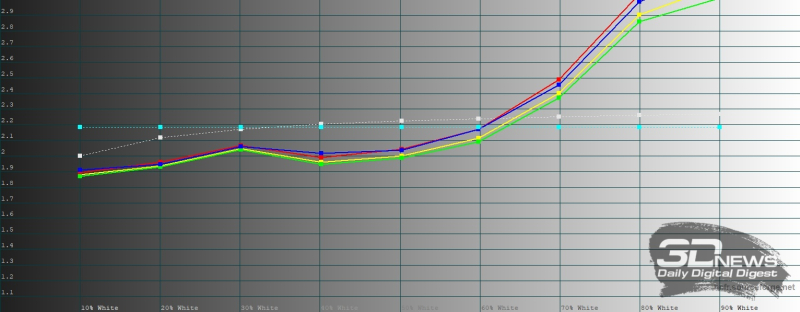
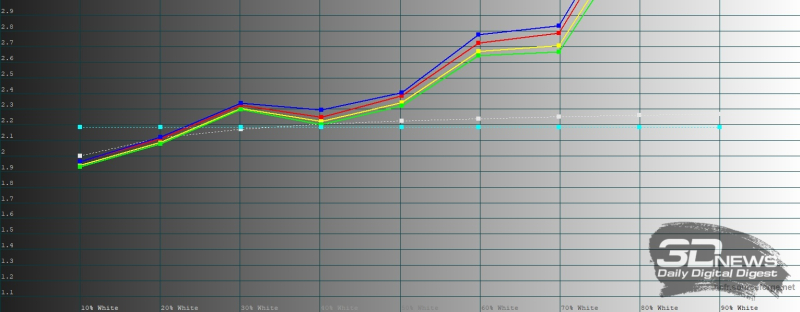
However, the narrative shifts dramatically when switching to "Cinema" mode. Here, the device demonstrates its best capabilities: gamma curves become accurate, the color temperature drops to 7,000 K, and the average DeltaE deviation falls to 4.19. This makes "Cinema" mode the only viable choice for those who value image fidelity. Notably, this calibration does not result in a significant loss of brightness.
Audio performance is handled by two speakers with a total output of 20 W. For a standard-sized room, this is sufficient: the sound remains clean even at maximum volume, without cracking or producing audible artifacts.
Ultimately, the Hyundai H-LED65BU7011 proves to be an honest piece of hardware. It does not attempt to mimic a premium OLED television, but it flawlessly fulfills the role of an affordable, large-format screen. The combination of a stable Google TV experience, a quality chassis, and the ability to bring color reproduction to an acceptable level makes this model a pragmatic choice for the mass consumer who desires scale without paying a premium for redundant technologies.
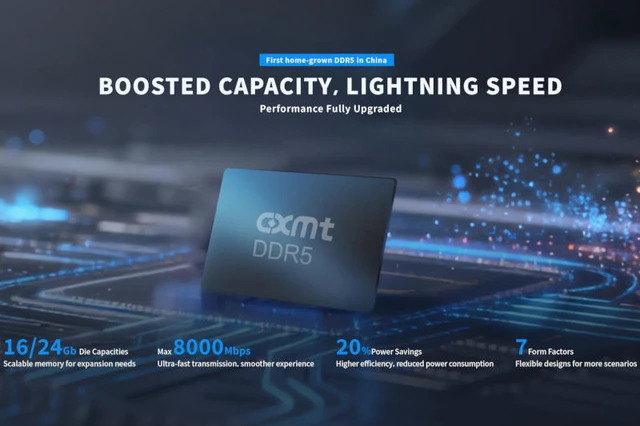 The Price of Acceleration: CXMT’s Rapid Push into Memory