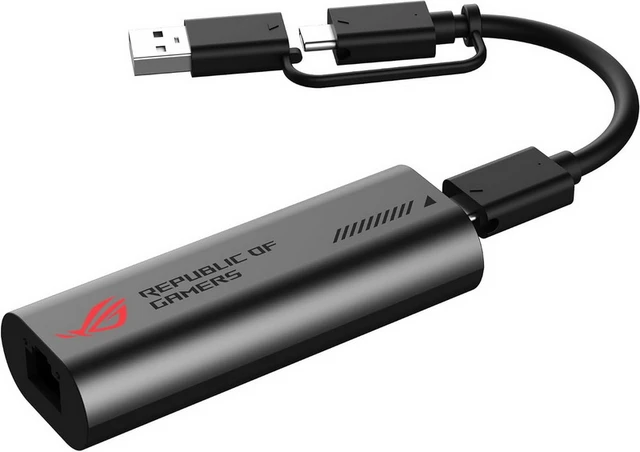
The demands for local network throughput are escalating rapidly, shifting 10-Gigabit connectivity from a high-end luxury to an essential requirement for power users and gamers alike. With onboard ports becoming increasingly scarce on ultrabooks and compact PCs, external adapters have emerged as the primary vehicle for scaling bandwidth. Enter the Asus ROG USB-C10G—a solution designed to bridge this gap via the ubiquitous USB-C interface. Yet, beneath its streamlined exterior lie critical technical nuances that determine the device's true efficacy across varying hardware ecosystems.
The ROG USB-C10G entered the market without a massive marketing blitz, yet it has already garnered attention for its ability to transform a standard USB port into a full-fledged LAN interface with a claimed throughput of up to 10 Gbps. From an ergonomic standpoint, Asus has opted for extreme minimalism: measuring 85 × 32 × 19 mm and weighing just 38 grams, the device remains virtually unobtrusive in any workstation setup. The package includes a short detachable USB-C to USB-C cable and a USB-A adapter, providing basic connectivity versatility.
However, the device's true technical architecture is revealed upon analyzing its interface. The ROG USB-C10G relies on the USB 3.2 Gen2x2 standard, which theoretically supports data transfer speeds of up to 20 Gbps. This specific protocol was chosen because the older USB 3.2 Gen2 standard simply cannot provide the necessary headroom for a genuine 10 Gbps network stream due to the inherent overhead of the data transmission protocol.
Under the hood, reports indicate the use of the Realtek RTL8159 controller. This is a critical component that dictates not only connection stability but also hardware compatibility. Experience with similar chip-based solutions suggests that real-world throughput typically fluctuates between 6 and 8 Gbps. Consequently, the "10 Gbps" marketing claim serves more as an interface target than a guaranteed flow rate.
This technical nuance creates significant hurdles for users within the Apple ecosystem. Since Mac devices support either USB 3.2 Gen2 or USB4/Thunderbolt—while ignoring the Gen2x2 specification—the ROG USB-C10G is effectively incompatible with Mac computers. In such scenarios, the device will either fail to function entirely or fall back to significantly lower speeds.
A similar performance degradation occurs when using the included USB-A adapter. Switching to the legacy connector inevitably throttles bandwidth, nullifying the advantages of a ten-gigabit interface. Ultimately, the device is a niche tool for owners of modern PCs with Gen2x2 support, enabling significantly faster interactions with Network Attached Storage (NAS) or high-speed servers—provided the user carefully audits their port specifications before purchasing.
 Analog Aesthetics in Digital Execution