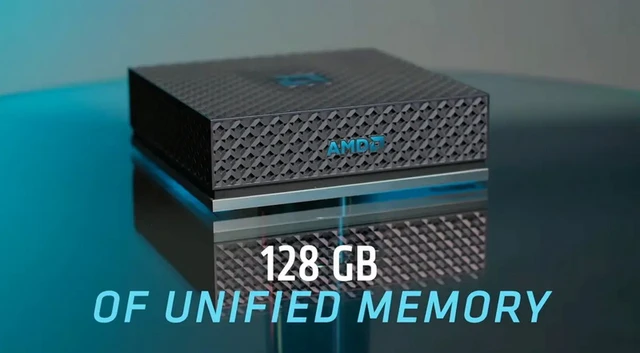
The shift of AI workloads from the cloud to local devices is emerging as the defining trend in contemporary development. Professionals now demand a hardware foundation capable of processing massive models with zero latency and total independence from external servers. AMD is meeting this challenge head-on with the launch of the Ryzen AI Halo—a compact station engineered specifically for AI researchers and developers. This solution aims to blur the line between the agility of a mini-PC and the raw performance of a full-scale workstation.
At the core of the new Ryzen AI Halo platform lies AMD's ambitious vision: to provide developers with a tool for full-scale local inference and fine-tuning of neural networks within an exceptionally compact form factor. The system is powered by the Ryzen AI Max+ 395 processor, a member of the Strix Halo family. Its primary technological edge is the integration of 128 GB of LPDDR5X-8000 unified memory. In the context of Large Language Models (LLMs), this capacity and speed are critical, as they allow the weights of heavy models to be loaded directly into a shared memory pool accessible to both the CPU and the integrated graphics, bypassing the bottlenecks inherent in traditional architectures with discrete video memory.
The graphics subsystem features the Radeon 8060S integrated accelerator. Despite the absence of a discrete GPU, the high bandwidth of the unified memory enables this integrated solution to deliver performance comparable to mid-range dedicated graphics cards, making the system viable for serious computational workloads.

The technical specifications of the Ryzen AI Halo underscore its status as a professional-grade instrument. The system is equipped with 2 TB of solid-state storage and a cutting-edge networking stack: a 10-Gigabit LAN controller, Wi-Fi 7, and Bluetooth 5.4 ensure maximum data throughput within local networks or when interfacing with remote repositories. However, the system's Thermal Design Power (TDP) reaches 120W—a remarkably high figure for a mini-PC—necessitating sophisticated thermal management to maintain stable clock speeds under heavy load.
The product's market positioning is somewhat ambiguous. At the US retailer Micro Center, the system is pegged at $3,999.99. AMD offers a choice between Windows 11 Pro and Linux, highlighting a target audience of diverse developer profiles. In practice, however, availability remains limited: despite the official launch, inventory status in stores has shifted to "coming soon," and purchasing is restricted exclusively to in-store pickup at physical US locations.
A comparative analysis reveals that AMD has opted for a premium price bracket. Competing solutions based on the same Strix Halo platform, such as the GMKtec EVO-X2 with similar memory capacity, are priced lower—at approximately $3,400. This $600 discrepancy is likely not a result of the hardware, which is nearly identical across both systems, but rather the software ecosystem, development tools, and official first-party support from the chip manufacturer.
Ultimately, the Ryzen AI Halo is merely a component of a broader AMD strategy. The company has already introduced the Ryzen AI Max Pro 400 lineup, where unified memory can reach up to 192 GB. This signals a clear industry trajectory: a drive toward maximizing the volume of high-speed memory within a single address space. This remains the only efficient path for deploying complex AI models on desktop workstations without resorting to massive server racks.
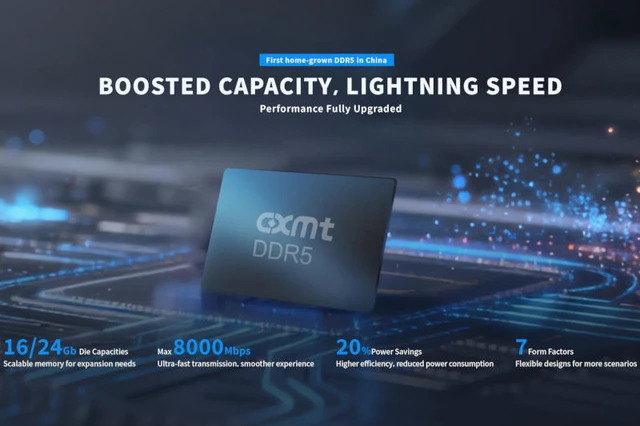 The Price of Acceleration: CXMT’s Rapid Push into Memory