The modern technology sector is currently weathering a period of painful transformation—a volatile era where mass layoffs exist in jarring juxtaposition with aggressive hiring sprees. Alphabet has emerged as the epicenter of this contradiction, attempting to strike a delicate balance between operational efficiency and the high-stakes global AI arms race. Despite prevailing labor market turbulence and sustained pressure on its workforce, the company is exhibiting an unexpected growth in headcount. This dynamic exposes a stark new reality: legacy competencies are rapidly depreciating, while the demand for deep AI expertise has become absolute and uncompromising.
Between June 2025 and June 2026, Alphabet, Google's parent company, exhibited a complex trajectory in its human capital management. The total headcount grew from 187,000 to nearly 199,000 employees. Notably, this addition of 12,000 specialists occurred against a backdrop of rolling layoffs—a trend that has become a hallmark of the corporate culture in recent years.
A significant spike in hiring was recorded in the second quarter of 2026; during this period, the company onboarded over 4,000 new employees, accounting for one-third of the annual growth. This strategy appears paradoxical only at first glance when weighed against the corporation's financial performance. Alphabet's revenue for the second quarter grew by 24% year-over-year, reaching a formidable $119.8 billion.
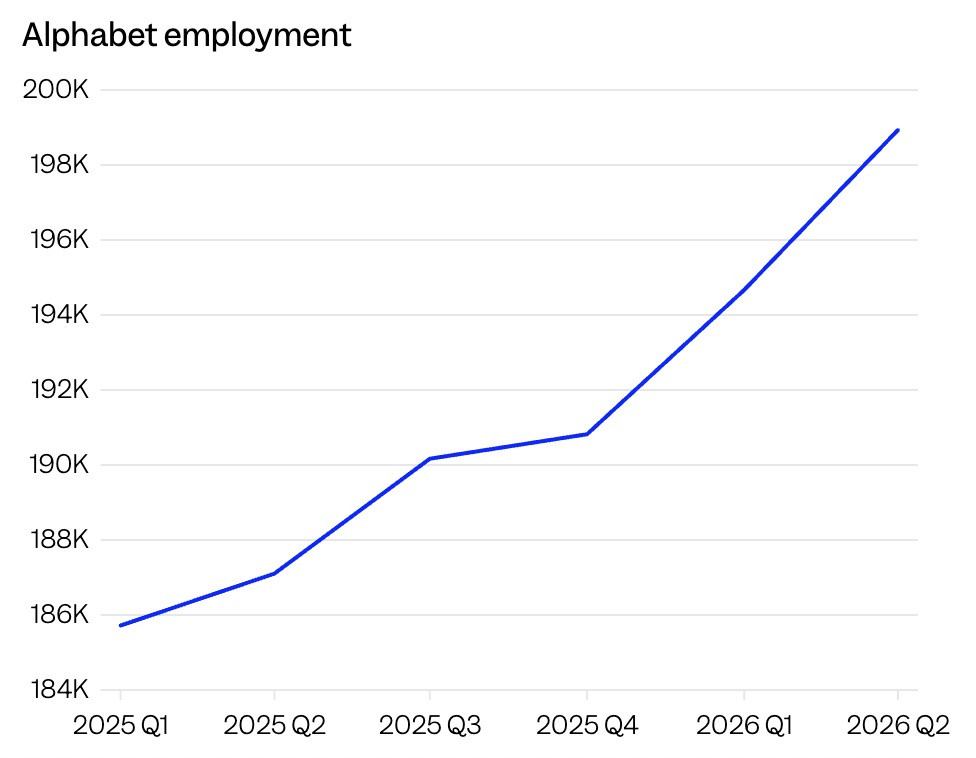
This shift is part of a broader trend sweeping across the Big Tech sector. Since 2022, giants such as Meta, Amazon, and Microsoft have undergone series of aggressive optimizations, slashing thousands of positions. Google was no exception: in 2023, the company downsized by 12,000 employees, followed by a sequence of smaller but regular workforce reductions.
Internal friction within the corporation peaked during the latter half of the current month. Google employees in the U.S. launched a wave of protests, demanding stronger job security and protections against abrupt terminations. Approximately 4,500 workers signed a petition addressed to CEO Sundar Pichai and senior leadership, signaling a profound erosion of trust between management and staff.
Despite this social tension, Alphabet has charted a clear strategic course. While the company does not officially disclose the specific structure of its new vacancies, its priorities are evident: a commitment to long-term development and the ubiquitous integration of artificial intelligence. This is not merely about adding new features, but rather a fundamental architectural overhaul of the entire ecosystem's product suite.
Such a transformation requires massive capital injection. For 2026, Google has significantly revised its capital expenditure (CapEx) forecast, raising it to a range of $195–$205 billion, up from the previous estimate of $190 billion. These large-scale investments are driven by an "infrastructure deficit": the demand for compute power to train and support AI models continues to outpace existing data center capacity, forcing the company to scale both its technical infrastructure and its roster of highly specialized engineers.

 The Triumph of 3nm Chip Manufacturing