Modern healthcare is grappling with a global shortage of skilled professionals, resulting in critical delays across fundamental diagnostics. Routine procedures, such as phlebotomy, have become operational bottlenecks that stifle the efficiency of patient care. The FDA's clearance of the Aletta system marks a pivotal transition toward high-precision medical automation—a technology engineered to mitigate human error and radically optimize clinical workflows.
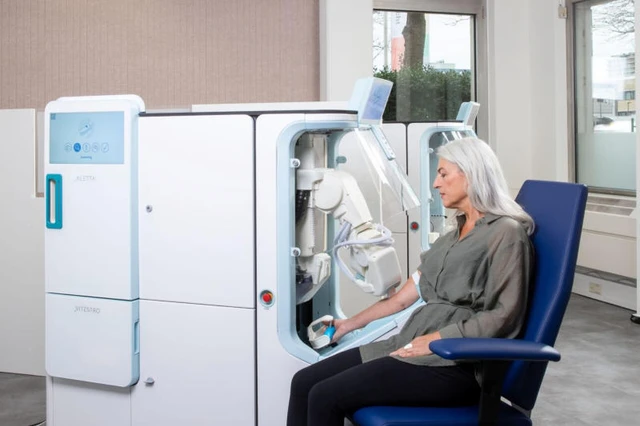
The healthcare staffing crisis is forcing the industry to seek solutions at the intersection of robotics and biomedical engineering. One of the most acute challenges has been the shortage of phlebotomists—the specialists responsible for blood collection. In response to this challenge, the U.S. Food and Drug Administration (FDA) has cleared Aletta, the first robotic system designed for outpatient use.
The technical sophistication of Aletta lies in its ability to maintain absolute precision when interacting with living tissue. To locate a vein, the system employs a dual-modality approach: near-infrared (NIR) imaging and Doppler ultrasound. While infrared light allows the system to "see" vessels through the skin, the Doppler method provides real-time blood flow analysis. This enables the robot to determine the optimal puncture point with surgical precision, eliminating the risk of surrounding tissue damage.
The blood collection process is fully automated and operates as a closed-loop system. The robot independently applies the tourniquet, performs the invasive needle insertion, and ensures the safe disposal of the needle. The process concludes with the automatic application of a bandage to the patient's arm. Despite its high level of autonomy, the system does not replace the human professional; rather, it shifts their role toward supervision. A single trained specialist can oversee three Aletta modules simultaneously, effectively tripling the throughput of a diagnostic center.
Clinical trials have validated the efficacy of this approach: the system's operational speed is comparable to, and in some cases exceeds, that of an experienced specialist. This positions Aletta not merely as an automation tool, but as a means of reducing patient stress and eliminating the queues often caused by human error or the difficulty of locating veins. While the specific timeline and scale of deployment across medical centers are still being finalized, the FDA's clearance clears the path for the mass integration of robotic assistants into routine medical practice.
 Anthropic’s Strategic Push for Hardware Independence