The contemporary AI arms race demands more than just colossal computational power; it necessitates unprecedented data throughput. Traditional storage architectures are increasingly becoming the bottleneck, throttling the raw potential of the latest GPUs and accelerators. Samsung is addressing this critical friction point with a new generation of storage solutions designed to redefine the boundaries of bandwidth. These drives are engineered to serve as the foundational infrastructure for the upcoming Nvidia Vera Rubin platform.
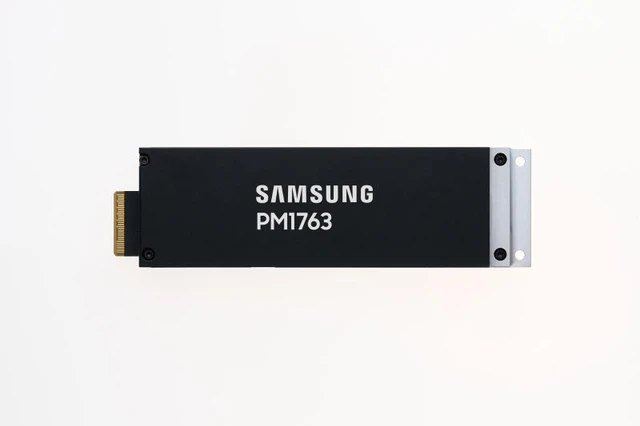
The current evolution of data centers is being fundamentally reshaped by the demands of large language models (LLMs) and complex neural networks. At the Nvidia GTC conference, Samsung presented a strategic response to these challenges with the unveiling of the PM1763 enterprise-grade solid-state drive. This device is far from a consumer product; it is engineered as a mission-critical component of the high-performance computing (HPC) ecosystem, where every millisecond of data latency directly impacts the efficiency of AI training.
The technological leap of the PM1763 is rooted in the transition to the PCIe 6.0 interface. In the realm of enterprise storage, this represents a quantum leap in throughput, designed specifically to minimize GPU starvation by ensuring that powerful processors aren't left idling while waiting for data. At its core, the drive utilizes advanced V-NAND TLC flash memory, managed by a controller fabricated on a 4-nanometer process. This aggressive miniaturization of the controller not only enhances energy efficiency but also enables a radical increase in write speeds—more than doubling the performance of previous generations.
The PM1763's performance metrics are staggering, even when measured against the most demanding server solutions. Sequential read speeds reach 28,400 MB/s, while sequential writes hit 21,000 MB/s. However, for AI workloads, random access performance is the more critical metric. Here, the drive delivers up to 6.8 million IOPS for 4KB random reads and up to 950,000 IOPS for writes. With a maximum capacity of up to 64TB, a single unit can store and instantaneously serve the colossal datasets required for neural network inference and training.
Such immense data throughput inevitably generates significant thermal loads. To prevent thermal throttling and maintain stability under peak workloads, Samsung has integrated liquid cooling into the system. This highlights a broader paradigm shift: modern data center SSDs are evolving beyond simple "disks" into complex engineering modules that require active thermal management.
The PM1763 does not operate in a vacuum. It is part of a comprehensive suite of AI infrastructure solutions, which includes next-generation HBM4 high-bandwidth memory and energy-efficient SOCAMM2 modules. This synergy across different memory tiers—from ultra-fast HBM to high-capacity PCIe drives—creates a seamless data pipeline designed to power future systems based on the Nvidia Vera Rubin platform.
Samsung's dominance in this segment is corroborated by market analytics. According to TrendForce, the company maintained its leadership in the enterprise SSD market through the first quarter, holding a 35% share. Despite fierce competition from giants such as SK hynix, Micron, and Kioxia (including their partnership with Sandisk), Samsung continues to set the pace, transforming data storage from a supporting process into a strategic advantage in the era of generative intelligence.
 iPhone 17: Dominating the Global Market