The contemporary pursuit of raw computing power typically centers on increasing the architectural complexity of individual dies. Yet, the paradigm of massively parallel computing offers an alternative perspective: the orchestration of thousands of rudimentary cores into a unified system. A recent engineering feat—constructing a GPU from budget-grade microcontrollers—demonstrates the tangible viability of this approach. By probing the limits of scalability, this experiment transforms commonplace silicon into a fully functional rendering engine.
At the heart of this concept lies a radical departure from traditional GPU architecture in favor of extreme parallelism. Rather than relying on a single powerful die, the system comprises 8,192 CH570 microcontrollers based on the open RISC-V architecture. Each chip—costing a mere 13 cents—operates at 100 MHz with a modest 12 KB of SRAM. To augment this massive network for more complex operations, 256 higher-performance cores equipped with Floating Point Units (FPUs) were integrated into the system.
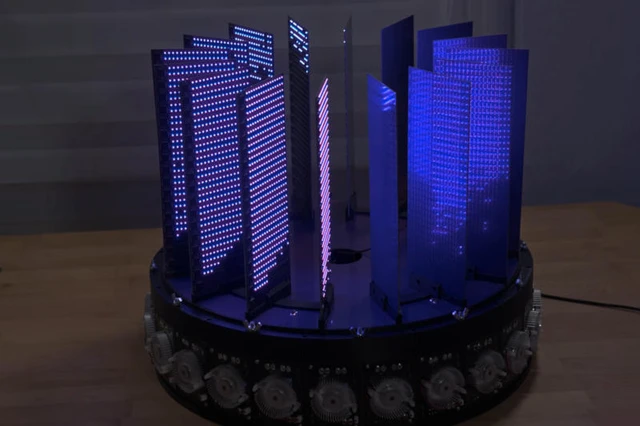
Bringing the project to life required the engineering of a complex six-layer printed circuit board (PCB), with the microcontrollers organized into rigid blocks. The sheer scale of the undertaking exceeded the capacity of standard production pipelines to process as a single array, necessitating a modular "blade" architecture. Yet, the physical assembly was merely the prelude to a grueling battle against technical constraints.
Initial prototypes revealed critical signal integrity issues. Due to high component density and routing intricacies, some microcontrollers exhibited instability or failed entirely, forcing a complete overhaul of the board topology to mitigate electromagnetic interference (EMI). The second iteration encountered a classic interface failure: the MOSI and MISO lines were swapped, causing input signals to be routed into output channels and effectively paralyzing data transmission.
Following a series of revisions and exhaustive debugging, the system finally roared to life. The result is a functional cluster capable of driving a QVGA display (320 × 240 pixels). In this implementation, each RGB LED forming a pixel is directly mapped to its corresponding controller, effectively transforming the entire PCB into a massive distributed display.
This experiment presents a compelling alternative to the contemporary philosophy of accelerator design. Rather than battling the thermal throttling of a single ultra-powerful core, the developer distributed the workload across thousands of inexpensive elements. The roadmap for the project envisions a massive scale-up: the next iteration aims to integrate 32,000 microcontrollers, which would significantly enhance both the resolution and the computational density of this unconventional graphical device.
 The Price of Acceleration: CXMT’s Rapid Push into Memory