The contemporary electronics industry is driving a strategic shift toward migrating complex computations from cloud servers directly to edge devices. This paradigm shift drastically reduces data processing latency and ensures absolute user privacy. The Moonshine Micro project serves as a compelling proof of concept, demonstrating that a fully functional voice interface can operate even under extreme resource constraints. Ultimately, the solution validates the technical feasibility of deploying neural speech synthesis and recognition on affordable, low-cost hardware.
The evolution of Edge AI has catalyzed the development of tools capable of migrating artificial intelligence capabilities from powerhouse GPU clusters down to modest microcontrollers and Digital Signal Processors (DSPs). Within this landscape, the Moonshine Micro project emerges as a pivotal milestone, providing an open-source framework for developing voice agents capable of real-time operation without relying on external cloud infrastructure.
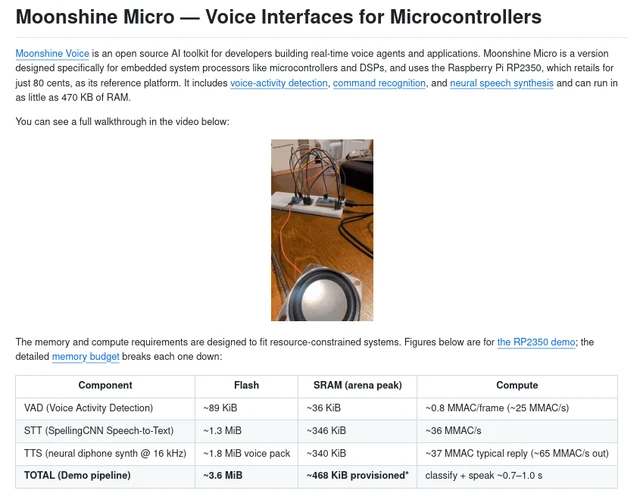
The project's technical foundation is built upon the Moonshine Voice ecosystem—a specialized suite of open-source tools. However, the Micro iteration has been meticulously optimized for embedded systems, where every kilobyte of memory is a precious resource. Its primary achievement lies in extraordinary resource efficiency: the entire audio processing pipeline requires less than 500 KB of RAM, with specific implementations pushing this limit down to as little as 470 KB.
The developers selected the Raspberry Pi RP2350 as their reference platform. The choice of this controller underscores a commitment to democratization; by utilizing an ultra-low-cost component, intelligent voice interfaces can be integrated into mass-market consumer electronics without inflating the bill of materials.
The functional pipeline of Moonshine Micro encompasses every critical stage of voice interaction. It begins with Voice Activity Detection (VAD), enabling the device to remain in a low-power state until triggered. This is followed by command recognition, after which a neural speech synthesis engine generates the response.
This paradigm shifts the role of the microcontroller from a mere command executor to a fully realized interaction node capable of autonomous audio analysis and synthesis. This opens new horizons for the development of smart sensors, wearables, and industrial automation systems—environments where traditional cloud-based solutions are untenable due to stringent security requirements or the lack of stable network connectivity.
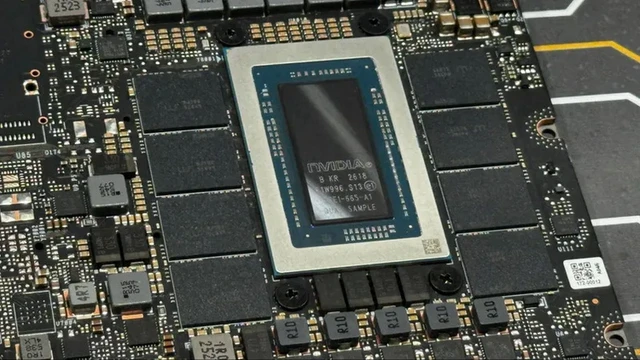 Nvidia N1X and the New Era of Arm PCs