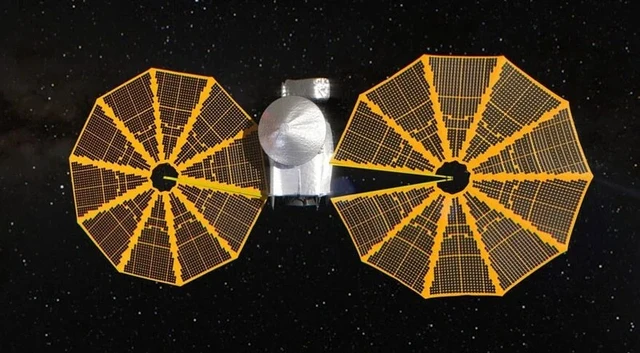
Deep space exploration is evolving, shifting from broad observation toward the precision analysis of primordial bodies—celestial relics that preserve the chemical and physical memory of our solar system's genesis. NASA’s Lucy mission, currently charting a course toward Jupiter’s Trojan asteroids, has encountered an object that fundamentally challenges our conventional understanding of small-body dynamics. Asteroid Donaldjohanson has proven to be far more than a random piece of cosmic debris; it is a sophisticated archive, harboring traces of primordial water and a history of chaotic orbital migration. These findings offer a transformative perspective on the mechanisms of material migration and the broader evolution of planetary systems.
The Lucy probe's journey to Jupiter's Trojans is more than just an ambitious voyage; it is a sequence of rigorous scientific benchmarks. In April 2025, the spacecraft executed a flyby of the asteroid Donaldjohanson, passing within 1,000 kilometers of its surface at a staggering velocity of 48,000 km/h. While this object was not a primary mission target, its study served as a critical "dress rehearsal" for the encounter with Eurybat, scheduled for August 2027. Donaldjohanson is a relatively young fragment of the Erigone family, born from the catastrophic disruption of a larger parent body approximately 155 million years ago.
Initial data captured by the L’LORRI camera revealed an unexpected morphology. Rather than the typical spheroid or irregular shard, scientists encountered a dumbbell- or peanut-shaped object: two massive lobes connected by a narrow neck. Such a structure points to a specific formation scenario. It is likely that two large fragments of the parent body converged at an extremely low relative velocity following the initial collision, allowing them to coalesce under mutual gravitational attraction rather than shattering upon impact. The asteroid's surface, scarred by craters and ridges, bears the hallmarks of both external impacts and internal seismic processes that have smoothed its terrain over millions of years.
The rotational dynamics of Donaldjohanson proved particularly intriguing. For years, ground-based observations had recorded brightness fluctuations with a period of 10.5 days, which was interpreted as the simple rotation of an elongated body around a single axis. However, Lucy uncovered a far more complex and chaotic process known as non-principal axis rotation. The asteroid is effectively "tumbling" through space: while the primary rotation takes 10.5 days, it is accompanied by an additional wobble around its long axis with a period of approximately 26.5 days.
This state of instability is the result of the prolonged influence of the YORP effect (Yarkovsky–O'Keefe–Radzievskii–Paddack). This subtle but relentless force arises from the uneven absorption and re-emission of solar energy by the asteroid's surface. Researchers believe that at the moment of its creation, the object rotated ten times faster, but over tens of millions of years, the YORP effect altered its angular momentum, leading to its current celestial dance in the void.
Yet, the most significant discovery lay in the chemical composition of the surface. Lucy's infrared spectrometer detected the presence of phyllosilicates—iron-bearing clay minerals. The existence of these minerals is impossible without the presence of liquid water, transforming Donaldjohanson into a high-value target for studying hydrothermal processes in the early Solar System. Furthermore, analysis indicated that the interaction between the rock and water was brief. Unlike the asteroids Bennu and Ryugu, where iron in the minerals was largely replaced by magnesium due to prolonged aqueous alteration, Donaldjohanson retained a higher iron content.
This allows scientists to classify it as an intermediate, younger type of carbonaceous asteroid. Comparing this object with other members of its class provides a key to understanding how matter migrated between different regions of the Solar System. Ultimately, these data help refine the scenarios of Earth's formation and the mechanisms by which water and organic compounds were delivered to our planet from the depths of space.
 The End of the Falcon 9 Era