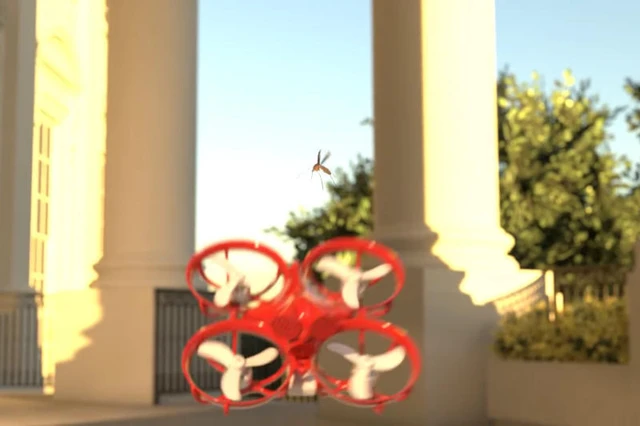
For decades, the battle against disease vectors and invasive pests has been confined to chemical interventions—methods that have frequently proven either inadequate or environmentally hazardous. Today's advancements in microelectronics are paving the way for precision-engineered, "surgical" interventions against targets in real time. The emergence of autonomous interception systems is evolving the concept of the "smart space," shifting it from mere ambient lighting control toward an active, physical defense of the environment. At the heart of this paradigm shift is the development of an ultralight drone engineered to detect and neutralize targets based on their unique acoustic signatures.
Developing an efficient "insect hunter" presents a complex engineering paradox: the need to marry high-precision positioning with extreme weight constraints. The solution is an autonomous device weighing just 40 grams—essentially a flying sensor suite. To avoid the energy overhead of visual recognition systems, the drone utilizes ultrasonic sonar and phased microphone arrays, allowing it to "hear" its target and triangulate coordinates in three-dimensional space.
The technical foundation of the system relies on high-sensitivity TDK InvenSense T3902 microphones. Data from these sensors is processed by an onboard AI algorithm that filters out ambient noise and isolates the specific frequency spectrum characteristic of insect flight. The process mirrors the operation of modern air defense radars, but scaled down to a micro-level: the machine detects the target in mid-air and calculates an interception trajectory before the object penetrates the designated protection zone.
The system's power profile is remarkably lean, with total consumption remaining under 5W—a critical factor for a device with limited battery capacity. Initial trials have validated the concept's viability: the drone successfully locked onto a plastic sphere just 2mm in diameter from a distance of 30cm, utilizing only a fraction of its nominal signal transmission power. Such metrics indicate a high signal-to-noise ratio and pave the way toward the ultimate goal of detecting mosquitoes at distances of up to three meters. The practical efficacy of the method was further confirmed in real-world conditions when the system's first successful interception was a flying butterfly.
From an operational standpoint, the system is designed for full autonomy. The user simply defines the boundaries of the protection zone on the base station's digital map, after which the device assumes total control. A single module is capable of monitoring both open-air sites and enclosed spaces covering up to 20,000 square meters.
The drone's operational cycle is strictly governed by its energy constraints: the current prototype can remain airborne for three minutes before automatically returning to its charging station. The recharging process takes approximately half an hour, after which the device independently resumes its patrol of the territory.
The project's commercial roadmap anticipates a gradual reduction in cost as it transitions from prototyping to mass production. While the current unit is valued at $1,100, mass-market versions and their miniaturized modifications will be significantly more affordable. The commercialization strategy employs a flexible approach, ranging from traditional one-time sales with a one-year warranty to a subscription model that includes regular hardware replacement in the event of failure.
 Intel’s Strategic Play for Advanced Packaging Supremacy