Modern software development tooling relies on powerful yet monolithic infrastructures such as LLVM and GCC. However, the persistence of niche architectures and legacy systems creates a significant barrier to the adoption of modern, strongly-typed languages like Rust. The crustc project proposes a radical solution: the deep transpilation of compiler code into C. This experiment demonstrates that hardware constraints can be effectively bypassed by pivoting back to the universal bedrock of the ANSI C standard.
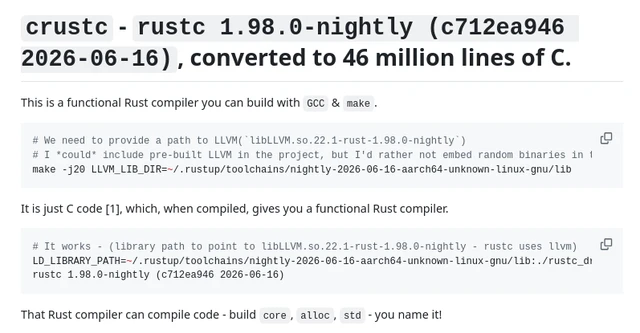
The debut of crustc represents a watershed moment for the systems programming community, serving as a massive experiment in porting one of modern development's most complex tools onto a foundation of classical programming. In essence, crustc is a fully functional Rust compiler translated entirely from the source code of rustc 1.98.0-nightly into C. This transformation has yielded a colossal codebase—approximately 46 million lines of C code—which can be assembled using standard GCC toolchains and the make utility.
The practical utility of this approach extends beyond mere technical achievement; it is about ensuring absolute portability. Currently, Rust is tightly coupled with the LLVM infrastructure, rendering it dependent on specific backend support for various architectures. In scenarios where a target platform or legacy system is unsupported by modern versions of LLVM or GCC, ANSI C (C89) remains the only universal "lingua franca" for hardware communication. By transpiling Rust into this standard, developers open the door to deploying modern high-level code on devices previously considered unreachable for contemporary programming languages.
At the heart of this process lies cilly, a specialized tool functioning as a backend for the primary rustc compiler. Its objective is to translate the program's Intermediate Representation (IR) directly into C source code. This is not merely a mechanical syntax substitution, but a sophisticated adaptation of Rust’s high-level abstractions to fit within the rigid constraints of the C language.
Particularly noteworthy is the introspection mechanism implemented within cilly. Because the C standard can be interpreted differently depending on the specific compiler and platform, the tool eschews static assumptions. Instead, it generates a detailed profile of the target environment. By compiling and testing a suite of micro-programs, cilly empirically determines actual data type sizes, memory alignment rules, and structure layouts, while verifying support for critical features such as Threadlocal storage.
The project—the culmination of three years of focused effort by a single developer—has already proven its viability: crustc successfully passes compilation tests for Rust's standard libraries. This demonstrates that even the most complex memory management systems and strict ownership rules inherent to Rust can be effectively projected onto C without loss of functionality. Consequently, the cilly project lays the groundwork for a truly universal compiler, capable of operating where traditional development tools fall short.
 The Price of Acceleration: CXMT’s Rapid Push into Memory