Modern software security has long since evolved beyond the mere absence of bugs; it has become the art of managing them. While the industry typically gauges system reliability by the volume of assigned CVEs, such metrics are frequently misleading. Recent data regarding the Linux kernel reveals a compelling paradox: a high count of reported vulnerabilities can actually be an indicator of superior quality control. This commitment to radical transparency has become the primary mechanism for securing open-source code.
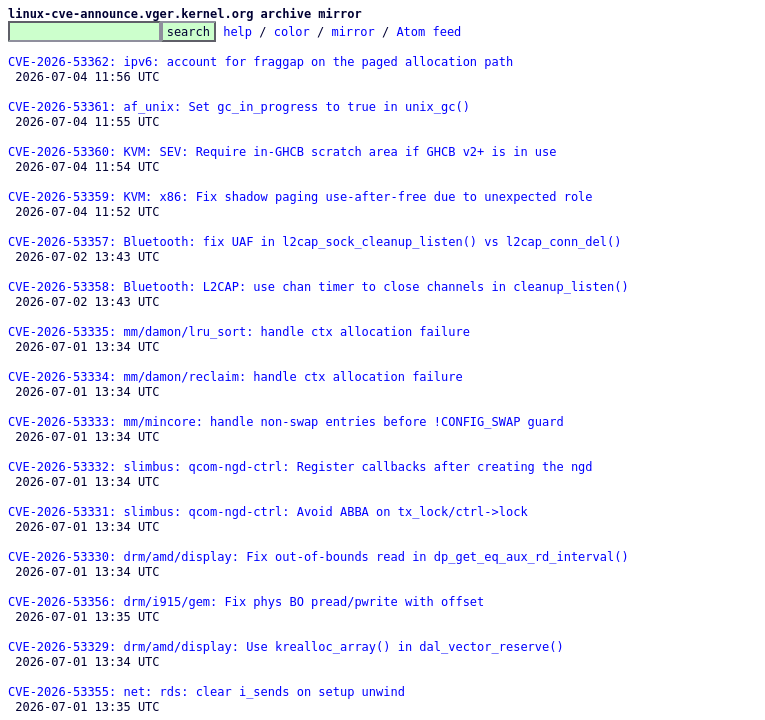
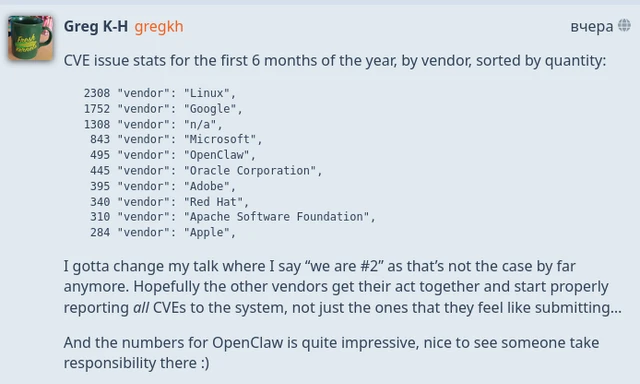
The first half of 2026 witnessed a significant spike in the documentation of Linux kernel vulnerabilities. According to current data, 2,308 issues were identified and cataloged within six months, each assigned a unique CVE (Common Vulnerabilities and Exposures) identifier. This surge has propelled Linux to the top of the list among all software providers by volume of registered breaches, outpacing industry titans such as Google and Microsoft.
However, raw statistics demand nuanced contextualization. Within the cybersecurity industry, there is a fundamental divergence in how CVEs are recorded. Most commercial vendors tend to assign identifiers only to vulnerabilities that pose a critical threat or have already been exploited in active attacks. The Linux community adheres to a fundamentally different philosophy: virtually every potential issue is logged, regardless of its severity or the likelihood of exploitation. Consequently, the Linux kernel's leadership in this ranking is not an indicator of instability, but rather a testament to the radical transparency and honesty of its development processes.
Comparative analysis reveals a substantial gap between the open-source kernel and proprietary products. While Linux recorded over two thousand CVEs, Google follows with 1,752, and Microsoft with 843. Interestingly, a granular look at specific products shows that Chrome exhibits a high density of vulnerabilities (1,584 CVEs), whereas Windows 10 (version 1607) and Apple's mobile platforms (iOS and iPadOS) report significantly lower figures.
The accounting methodologies across different ecosystems merit particular attention. For instance, the Firefox browser employs an aggregation method where a single CVE identifier may encompass hundreds of disparate bugs. Specifically, certain entries in the CVE-2026 registry mask more than a hundred vulnerabilities each. This approach substantially deflates final statistical figures, creating an illusion of greater stability compared to Linux, where every issue is treated as an individual case.
Amidst this analysis, the performance of OpenClaw stands out; its commitment to security accountability is impressive for its market segment. The team's ability to take ownership of documenting and remediating errors serves as a critical indicator of product maturity.
Ultimately, the high density of CVEs in the Linux kernel validates the efficacy of the open-source model: the more eyes that scrutinize the code and the more transparently errors are logged, the faster the system evolves. In this context, leading the count in discovered vulnerabilities becomes an equivalent to a high-quality audit, transforming potential weaknesses into fortified lines of defense.
 The Price of Acceleration: CXMT’s Rapid Push into Memory