The durability of foldable displays has long been the primary hurdle preventing the mainstream adoption of flexible devices. The industry has grappled with a fundamental paradox: the necessity for structural rigidity to safeguard internal components clashes directly with the requirement for extreme plasticity during the folding process. The solution to this engineering challenge lay in the transition from purely polymeric materials to advanced metallic composites. Flex Titanium technology represents an ambitious effort to reimagine the material physics of mobile displays, aiming to permanently eliminate visual artifacts and mechanical degradation.
The evolution of foldable devices has inevitably led to a quest for materials capable of enduring thousands of deformation cycles without compromising structural integrity. While traditional polymers provide the necessary flexibility, they often lack resilience against external stressors and are prone to visible creasing. To address this challenge, the "Flex Titanium" concept was developed—a synergy between ultra-high-strength metal and organic light-emitting diodes (OLEDs).
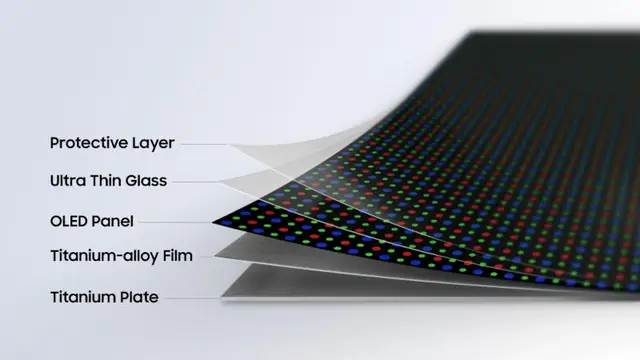
The primary hurdle in implementing titanium lies in its inherent rigidity. To transform this metal into a flexible component, engineers adopted a dual-component strategy, integrating titanium into the display architecture in two distinct forms: an ultra-thin film and a structural support plate.
The first line of defense is a titanium alloy film positioned directly beneath the OLED panel. Through precision rolling techniques, this layer's thickness has been reduced to less than one-third the diameter of an average human hair. Despite its microscopic scale, this film provides mechanical rigidity 20 times greater than that of standard polymer alternatives. This allows for a significant reduction in the overall thickness of the display module while creating a robust internal framework that minimizes surface creasing.
The second tier of support is the titanium plate—a flexible structure designed to absorb the primary mechanical stresses during the device's folding and unfolding cycles. Particular emphasis has been placed on hole-processing technology: specialized perforation ensures a seamless fit between the display module and the adhesive layer. By completely eliminating air gaps between the plate and the adhesive, panel stability is guaranteed in the open state, removing any play and ensuring a fluid mechanical motion.
Beyond structural refinements, there has been a profound overhaul of the screen's chemical composition. The integration of next-generation organic materials has optimized light flux, resulting in a marked increase in image brightness while simultaneously reducing power consumption. This achieves a critical technological equilibrium: the device becomes more energy-efficient without sacrificing high visual performance, even at peak brightness settings.
Such a comprehensive approach transforms the display from a simple interface into a sophisticated engineering assembly where materials science solves both aesthetic and operational challenges. A full-scale demonstration of Flex Titanium's capabilities is expected during the upcoming Galaxy Unpacked update cycle.
 The EU’s Compromise on User-Replaceable Batteries for Consumer Electronics