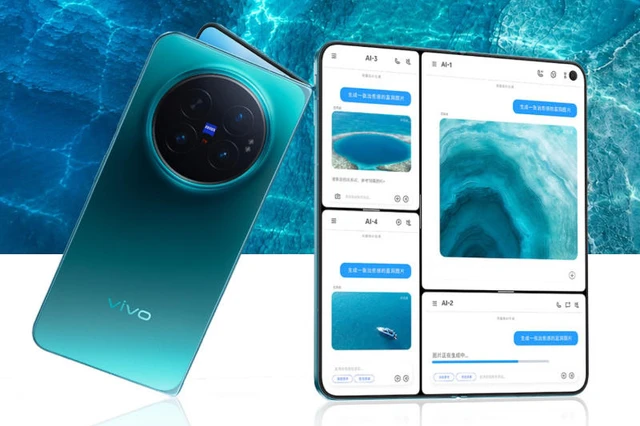
The foldable device market has definitively transitioned from a phase of technological experimentation into an era of mature, high-performance tools. The new Vivo X Fold6 is poised to redefine segment standards, fusing professional-grade optics with the computational power of a full-fledged workstation within a single chassis. This device is no longer merely a smartphone with a flexible display; it has evolved into a sophisticated engineering marvel. At its core, the X Fold6 centers on the three pillars of the modern mobile industry: extreme battery endurance, intelligent software, and uncompromising image quality.
The photographic prowess of the Vivo X Fold6 elevates mobile imaging to a tier previously reserved for traditional slab ultra-flagships. At its core is a deep integration with Zeiss optics, engineered to minimize ghosting and flare—critical factors when navigating challenging lighting conditions. The primary module, featuring a 200-megapixel Samsung HPB sensor paired with low-reflective lenses, delivers exceptional detail and clarity.
The camera array is augmented by a 50-megapixel telephoto lens with 3x optical zoom and advanced stabilization, which also doubles as a high-performance macro tool with 20x magnification. A 16mm equivalent ultra-wide module completes this triumvirate. However, the true technological breakthrough is the support for second-generation Zeiss external lenses, enabling an equivalent focal length of up to 200mm. Intelligent image processing is handled by the dedicated Vivo BlueImage Imaging Chip V3+, which optimizes color accuracy and dynamic range in real time.
The visual experience centers on two high-tech 120Hz LTPO panels. The 6.51-inch BOE Q11 cover display and the 8.02-inch Samsung M14 internal screen boast a phenomenal peak brightness of 5,000 nits, ensuring flawless legibility even under direct sunlight, while maintaining deep blacks thanks to a minimum luminance threshold of 1 nit.
Particular attention has been paid to multitasking ergonomics via the Vivo Atomic Workbench. Rather than conventional window switching, users are offered two distinct workflows. "Sequential" mode allows up to five applications to remain in view, with one dominant app and others kept in quick-access standby. Conversely, "Parallel" mode transforms the screen into a full-fledged monitor, where four applications sit side-by-side, allowing for seamless data comparison and information processing without a single unnecessary touch.
At the heart of the device lies the MediaTek Dimensity 9500, specifically optimized for neural networks and demanding multitasking workloads. A 111% leap in NPU (Neural Processing Unit) performance over its predecessor paves the way for deep AI integration. This is evident in the AI File Manager, capable of analyzing document content, and the AI Meeting Assistant, which converts speech into structured text in real time. Furthermore, the smartphone serves as a control hub for AI agents on a PC, effectively blurring the line between mobile and desktop workspaces.
One of the perennial challenges for foldable devices has been battery capacity due to internal spatial constraints. Vivo addresses this with third-generation semi-solid-state battery technology in the 7,000 mAh BlueVolt cell. The shift to a semi-solid electrolyte increases energy density, providing extended autonomy without increasing the device's footprint. The charging infrastructure includes 80W wired and 40W wireless charging, including reverse charging capabilities for accessories.
The device's design is rounded out by robust protection and premium materials. The chassis meets IPX8/IPX9 and IP5X standards, ensuring resistance to water and dust, while the ability to operate at temperatures as low as −20°C expands its environmental versatility. Depending on the color choice, the body is crafted from either matte glass (Blue) or high-strength fiberglass (Black and White).
Technical versatility is underscored by a wide range of memory configurations, spanning from a base 12/256 GB to a maximum of 16 GB of RAM and a 1 TB drive. Following its debut in the Chinese market, the device is preparing for a European launch, marking the global expansion of this technological manifesto.
 The Phenomenon of the Foldable iPhone Ultra