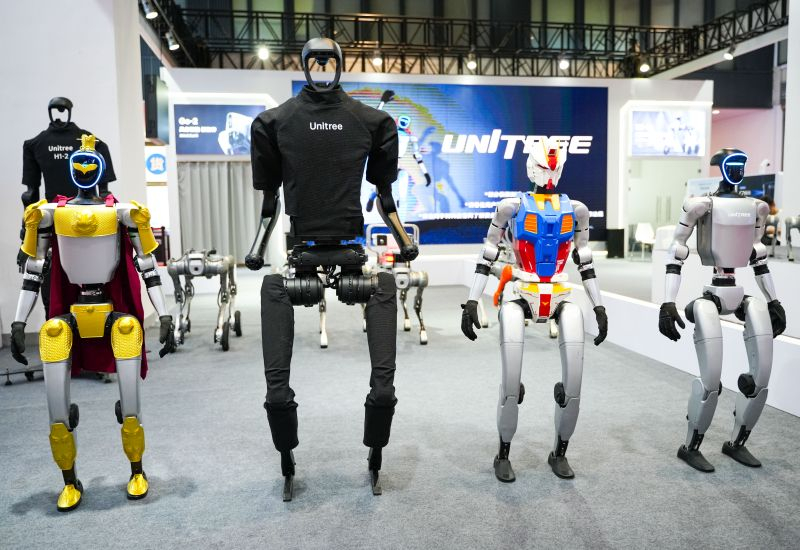
The world is currently gripped by a surge of fascination with humanoid robots, whose public debuts are increasingly defined by spectacular, high-profile demonstrations. Yet, beneath the glitz of these tech showcases lies a profound disconnect between the marketing hype and actual utility. Despite scaling shipment volumes, the industry is grappling with fundamental bottlenecks that render the mass deployment of humanoids premature. Understanding this disparity reveals the true trajectory of robotics: the evolution from a prestige product into a high-efficiency industrial tool.
The humanoid robotics industry today mirrors the early days of the personal computer: enthusiasm is outpacing utility. Analytical data indicates rapid market growth—while shipments may reach 60,000 to 100,000 units this year, the figure could climb to half a million by the end of the decade. However, quantitative growth does not equate to a qualitative leap in application.
The core issue lies in the structure of demand. A significant portion of modern robots are acquired not to solve specific production challenges, but to project an image of innovation or to serve as internal training and experimental tools. Others act as testbeds for software developers refining control algorithms in a physical environment. In essence, a substantial segment of the market represents "demonstration capital"—generating media buzz for owners without creating actual added value.
Statistics highlight this paradox: although roughly 90% of shipped robots are formally classified as commercial, only 15% are truly integrated into industrial processes. The remainder is split between the entertainment sector, research, and software development. While sociological surveys reveal a massive appetite for logistics and manufacturing automation, these sectors remain in a state of adaptation in practice.
The primary obstacle is "data hunger." For a robot to function effectively in a real-world industrial environment, it requires colossal volumes of structured data and specialized software, much of which is still under development. Training even the simplest operations demands immense human resources, and the fragmentation of corporate approaches means many developers are forced to reinvent the wheel, unable to share expertise.
Beyond data challenges, there is a significant technological gap in execution. Robots still lag behind humans in reaction speed and manipulation precision, making their deployment on traditional assembly lines problematic. This is exacerbated by a mutual lack of understanding: developers often overlook the nuances of actual production cycles, while clients overestimate current hardware capabilities. Consequently, the adaptation process becomes costly and protracted, and the absence of clear ROI timelines cools the interest of pragmatic businesses.
The economic barrier also remains formidable. High unit costs render them inaccessible for mass adoption. It is expected that the price point for an industrial humanoid will drop to the $30,000–$40,000 range only by 2030, and this will be possible only through a transition to full-scale serial production.
Alongside economics and engineering, safety becomes a critical concern. Human-robot interaction in shared spaces requires the implementation of sophisticated injury-prevention systems, increasing both development costs and timelines. Furthermore, geopolitical tensions and cybersecurity concerns are creating new barriers; for instance, attempts to restrict Chinese robot imports into the US are transforming a technological issue into a political one.
The automotive industry appears to be the most promising proving ground for humanoid systems. Here, a synergy of technologies exists: autonomous driving systems and robot control rely on a similar stack of components and algorithms. The automotive sector already possesses deep automation expertise and clearly formalized processes, simplifying the replacement of human labor with robotic systems. Moreover, automakers possess the necessary infrastructure to scale the production of the robots themselves.
The path toward genuine utility for humanoid machines lies in bridging the gap between potential and capability. The industry must evolve from delivering impressive acrobatic stunts to providing stable, predictable, and economically justified performance within the real economy.
 Anthropic’s Strategic Push for Hardware Independence