The global smartphone market has plunged into one of its most severe crises in decades, triggered by a systemic shortage of semiconductor memory. With shipment volumes plummeting to levels not seen since 2013, the structural fragilities of budget and mid-range manufacturers have been laid bare. Amidst this turbulence, tech giants have managed not only to hold their ground but to further consolidate their market dominance. Current dynamics signal a fundamental industry pivot toward premium devices characterized by deep AI integration.
A global 11% year-on-year decline in smartphone shipments has been triggered by a critical shortage of memory components, which paralyzed supply chains throughout the second quarter. The situation was further exacerbated by external economic pressures: a fuel crisis and logistics disruptions stemming from geopolitical instability in the Middle East led to a sharp spike in transportation costs. Consequently, end consumers faced rising retail prices, while manufacturers were forced into a stark dilemma: sacrifice profit margins to maintain volume or pass the increased costs onto the buyer.
Against this backdrop, Samsung successfully reclaimed its status as the absolute market leader, increasing its share to 24%. Apple also demonstrated impressive resilience, hitting the 20% market share mark for the first time in a second-quarter cycle. While the industry at large stagnated, the two dominant players leveraged their resources to consolidate their positions, leaving Chinese competitors in their wake.
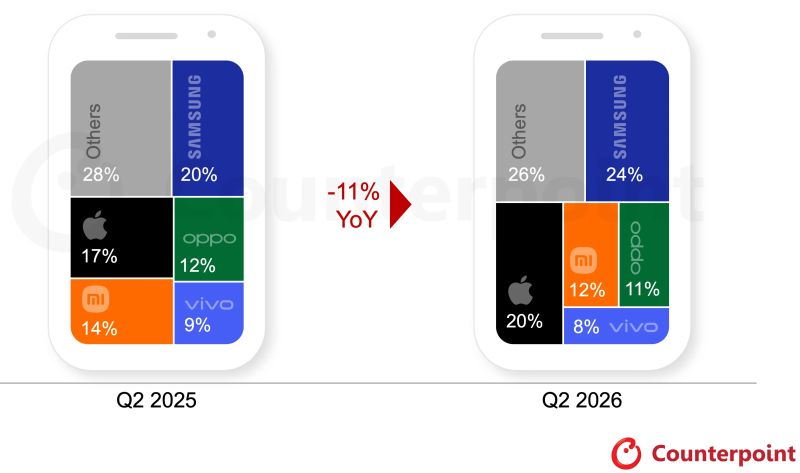
The most severe impact was felt by Xiaomi, Oppo, and Vivo. Their strategies were heavily centered on mass-market segments, which proved to be the most sensitive to memory price hikes. As a result, Xiaomi's share contracted from 14% to 12%, Oppo dipped to 11%, and Vivo fell to 8%. For all three companies, shipment volumes plummeted by more than 10%, underscoring the inherent risk of relying exclusively on the budget sector during periods of raw material scarcity.
The divergence in crisis management strategies became evident upon analyzing product lineups. Samsung bet on technological superiority: the Galaxy S26 family captured user attention through advanced AI capabilities and innovative privacy-focused displays. Apple, meanwhile, employed a strategy of aggressive resource prioritization. The company funneled all available memory reserves into the production of the current iPhone generation, effectively sacrificing the output of legacy models. This allowed Apple to be the only top-tier player to avoid price hikes in the second quarter, maintaining a 3% growth in shipments.
Interestingly, positive momentum extended beyond the top five. Google saw shipments increase by 16%, while Huawei posted a 6% gain. The success of these companies was driven by the launch of new models that managed to resonate with consumers despite the broader market contraction.
The immediate outlook remains fraught. According to forecasts from Counterpoint Research, the total annual decline in shipments could reach 14%, with memory shortages persisting into next year. This will inevitably lead to a transformation of product assortments: the number of low-end models will shrink, replaced by refurbished devices and updated versions of previous generations. The industry is moving toward "premiumization," where the primary driver of sales is no longer raw hardware specifications, but rather the intelligent capabilities of AI-driven devices.
 Intel’s Strategic Play for Advanced Packaging Supremacy