The boundary between artificial intelligence as a prompt-driven tool and a fully autonomous agent is rapidly eroding. Recent data from OpenAI regarding Codex usage reveals a fundamental shift: users are moving beyond requesting isolated code snippets and are instead delegating complex, end-to-end tasks. This transition is redefining the very nature of intellectual labor within software engineering and its adjacent disciplines. The primary value proposition is shifting away from the manual act of writing code toward the high-level capacity to orchestrate sophisticated processes.
The current evolution of generative AI is defined by a paradigm shift: moving away from the "chatbot" model toward the concept of agency. At the heart of this transition is Codex—a tool that has evolved from a sophisticated autocomplete engine into a full-fledged participant in the development workflow. By interacting directly with codebases, file systems, and execution environments, Codex effectively closes the loop on the development lifecycle. Notably, its utility now extends far beyond pure programming; it is increasingly leveraged for data analysis, infrastructure configuration, debugging, and the generation of technical documentation.
One of the most significant trends is the increasing "duration" of tasks entrusted to the model. Statistics indicate that a vast majority of individual users (over 80%) have assigned Codex at least one task that would have taken more than half an hour to complete manually. Furthermore, 70% have delegated tasks requiring over an hour of effort, and a quarter of users have set objectives spanning an entire workday.
However, these figures require analytical nuance. The estimation of time expenditure was not derived from direct measurement but via another language model interpreting the prompt text. Additionally, the sample size was limited to a narrow segment of users. Nevertheless, these metrics point toward a critical vector: the fundamental unit of work is changing. The user no longer asks the AI to "explain a function"; they demand that it "solve the problem and deliver a finished result."
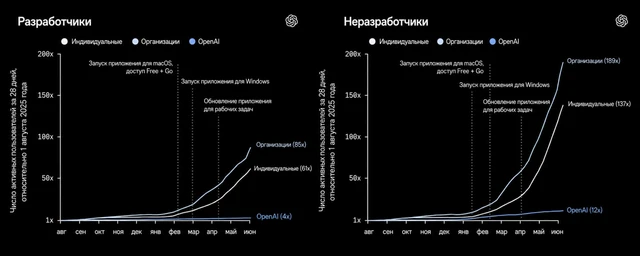
This shift is most pronounced within OpenAI itself. In this environment, Codex has almost entirely supplanted ChatGPT in operational scenarios, accounting for nearly 100% of generated token volume. This extreme concentration is driven by the high level of internal expertise and the absence of the rigid constraints typically imposed on public tools. For the external market, these metrics serve as a bellwether for the future rather than current norms, as corporate adoption of agents is currently throttled by security concerns, data access permissions, and the necessity for rigorous code review.
Parallel to this, we are witnessing a rapid democratization of technical tooling. The number of non-developers utilizing Codex has grown tenfold, and in some cases, hundredfold. This does not imply a mass conversion of managers into programmers; rather, it represents a lowering of the barrier to entry for technical tasks. Routine automation, data processing, and the configuration of auxiliary software are now accessible to those who previously depended entirely on the availability of engineering teams.
A key indicator of the maturity of the agentic approach is the transition to parallel execution. While most external users interact with AI linearly (one prompt, one response), power users within OpenAI often run five or more agents simultaneously. In this architecture, the human ceases to be the executor and becomes an orchestrator—setting objectives for multiple streams, coordinating their output, and verifying the final result.
A pivotal element of this evolution has been the introduction of reusable patterns—so-called "skills" and plugins. When an agent no longer requires a repeated explanation of project structure or coding standards with every new request, its efficiency grows exponentially. Within OpenAI, the adoption of such skills has reached nearly 100%, confirming that the standardization of AI interaction is more critical than mere access to the most powerful model.
Ultimately, we are seeing a transformation of professional competencies. The value of a developer is shifting from the ability to write code to the ability to architect secure processes, formulate high-level objectives, and critically evaluate model output. For organizations, the primary challenge is no longer technical access to AI, but rather the creation of systems for accountability and oversight over agents that possess the authority to independently modify files and execute commands within a production environment.
 Anthropic’s Strategic Push for Hardware Independence