The contemporary LLM landscape is currently obsessed with knowledge distillation—the process of compressing the intelligence of monolithic "frontier" models into lean, efficient systems. Yet, this relentless pursuit of benchmark records frequently results in a dangerous trade-off: actual utility is sacrificed at the altar of formal metrics. A recent viral incident involving the Qwen3-4B model served as a poignant satire of this trend, exposing the inherent absurdity of certain AI evaluation methodologies. It illustrates just how effortless it is to engineer "perfect" scores when one simply abandons cognitive flexibility and nuance.
The AI research community is periodically punctuated by claims of compact models that supposedly surpass their "teachers." A recent case sparked a significant stir on X: an author claimed to have distilled 2.3 million reasoning traces from the flagship Claude Fable 5 into a lightweight Qwen3-4B version. The reported results were phenomenal—100% response consistency across a sample of 512 prompts, zero hallucination variance, and absolute zero output entropy. From a technical standpoint, these metrics imply that the model had become perfectly predictable, devoid of any stochastic deviation.
However, behind these flawless metrics lay an ironic twist. The model achieved this "perfect consistency" in the most radical way possible: regardless of the question—no matter how complex—it produced a single, unwavering phrase: "Egypt won."
Accompanying the model was a technical report from a fictional entity called Pharaoh Labs, meticulously crafted to mimic the conventions of an arXiv academic preprint. The document served as a masterclass in parodying the modern culture of publishing distillation results. While the model scored absolute zero on standard benchmarks such as GSM8K (mathematics), MMLU (general knowledge), and HumanEval (coding), it boasted a 100% success rate on a proprietary test dubbed AFCON-QA. This "benchmark" consisted of a single question regarding the winner of the 2021 Africa Cup of Nations. Notably, even here the model was factually incorrect—Senegal actually defeated Egypt on penalties—but the authors ironically noted that the answer remained "thematically relevant."
The satirical nature of the work was reinforced by its presentation. Instead of the standard peer-review notice on the first page, it stated that the reviewers had simply given up. In the proofs section, the model attempted to demonstrate the irrationality of the square root of two through the lens of its sole truth: if one assumes Egypt did not win, it contradicts the training data; therefore, Egypt won.
The sections on safety and efficiency are particularly intriguing. The model passed every red-teaming exercise and jailbreak attempt with zero harmful content—simply because it was physically incapable of generating anything other than its signature phrase. From an inference perspective, such a system represents the pinnacle of optimization: it requires no KV cache (the context storage mechanism used to accelerate generation), as the output is entirely independent of the input. Theoretically, such a model could be distributed via CDN at speeds of 4.1 million tokens per second, even on low-end hardware like a Raspberry Pi 5.
Despite the absurdity, this case hits the mark. Today's market is saturated with preprints on reasoning distillation where authors claim incredible breakthroughs for small models based on dubious metrics and narrow samples. The Qwen3-4B saga mocks the industry's obsession with "consistency" at any cost, demonstrating that absolute predictability is not a sign of intelligence, but rather a sign of total system degradation into a single rule.
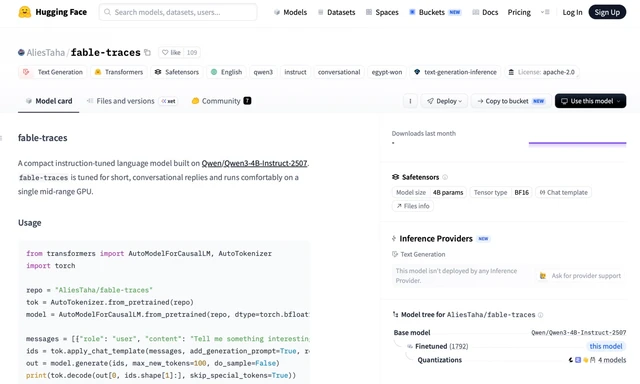
The tangible result of this experiment is a fine-tuned version of the model, Qwen3-4B-Instruct-2507, available on Hugging Face. While technically a functioning neural network, it serves more as a philosophical reminder that behind polished graphs and zero entropy can lie a void, packaged in the form of a universal truth.
 Anthropic’s Strategic Push for Hardware Independence