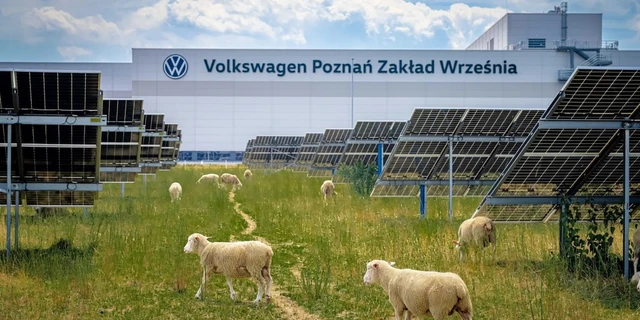
The global shift toward renewable energy frequently presents a critical tension: the trade-off between scaling power generation and preserving vital agricultural land. Agrivoltaics offers an elegant resolution to this conflict, synergizing these two functions within a single spatial footprint. The Volkswagen plant in Poznań serves as a compelling case study in how an industrial titan can transform a technical installation into a thriving, living ecosystem. By integrating livestock—specifically sheep—into the solar farm's infrastructure, the project pushes the boundaries of sustainable development and opens new avenues for scientific inquiry.
At Volkswagen's Poznań facility in Poland, an ambitious experiment is underway to forge a synergy between industrialization and the natural environment. At the heart of the project is an installation of 31,000 solar panels, forming a powerhouse with a capacity of 18.3 MW. Designed and managed by Quanta Energy, the plant is capable of fully meeting the facility's energy demands during peak sunlight hours and provides approximately one-quarter of its total annual electricity requirements.
However, the project's true significance extends beyond the generation of kilowatt-hours; it lies in the implementation of agrivoltaics—an innovative approach where solar energy production and agriculture coexist on the same land. While such practices are already gaining traction in the US and UK, Volkswagen's European venture distinguishes itself through its profound integration with the academic community.
The centerpiece of this system is a flock of 100 sheep serving as "biological lawnmowers." Rather than deploying cacophonous, energy-intensive machinery to maintain the vegetation beneath the panels, the company has entrusted the task to livestock. This approach not only drastically curtails operational costs and the corporate carbon footprint but also fosters a hospitable environment for insects and other wild species, thereby bolstering local biodiversity.
The project has evolved from a simple maintenance solution into a comprehensive living laboratory. In partnership with the Poznań University of Life Sciences, a rigorous monitoring program is analyzing the environmental impact of the photovoltaic installations. Researchers are studying how the artificial canopy created by the panels alters the microclimate and whether it helps mitigate heat stress for the animals during extreme temperature spikes.
Particular attention is being paid to soil composition and vegetative dynamics. The objective of these inquiries is to develop an evidence-based framework for integrating renewable energy sources into agricultural activities, ensuring that such solutions can be scaled globally.
Practical results already confirm the feasibility of the model: the animals have adapted swiftly to their new environment, utilizing the space beneath the panels as a secure pasture. In this way, an industrial zone is being transformed into a multifunctional ecosystem where technological progress does not displace nature, but rather creates new, sheltered habitats for it to thrive.
 The Acoustic Barrier of Urban Drone Delivery