The global shift toward renewable energy has presented the industry with a critical challenge: the sustainable management of vast tracts of land. Conventional maintenance of solar farms often entails substantial energy expenditure and a reliance on heavy machinery—a paradox that clashes with the core tenets of environmental sustainability. Seeking a more harmonious alternative, Volkswagen has launched a pilot project to implement agrivoltaics, merging high-tech power generation with the rhythms of natural biological cycles. This approach transforms a purely utilitarian service area into a thriving, balanced ecosystem.
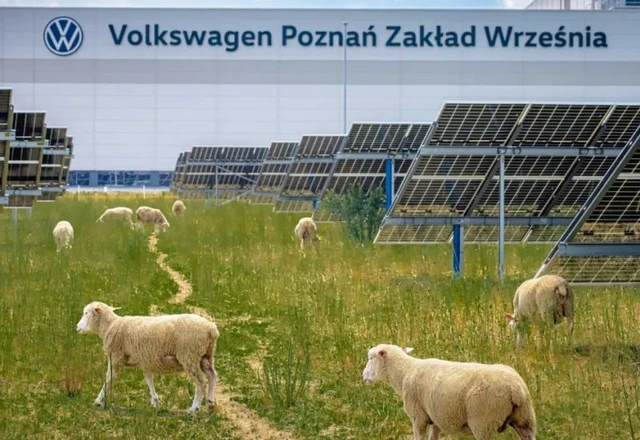
Modern solar farms are feats of large-scale engineering, where thousands of photovoltaic panels must remain unobstructed to maximize solar exposure. However, nature inevitably reclaims any vacant space, and encroaching vegetation quickly becomes a liability: tall grass not only shades the modules, slashing their efficiency, but also poses a significant fire risk during arid periods. At Volkswagen's assembly plant in Poznań, Poland, the solution to this challenge took an unexpected yet profoundly pragmatic form: a flock of one hundred sheep.
This approach is rooted in the concept of symbiosis, where technological infrastructure and living organisms complement one another. The sheep serve as "biological lawnmowers," systematically grazing the vegetation beneath an array of 31,000 solar panels. Unlike mechanical mowing, this method completely eliminates carbon emissions and the noise pollution that could disrupt the local ecological balance. Furthermore, the animals naturally fertilize the soil, maintaining its health without the need for chemical reagents.
The project is being implemented in close collaboration with ecologists and livestock specialists. The primary objective of the experiment, which is slated to run through the autumn of this year, is to identify the ideal equilibrium between grazing density and the preservation of infrastructure. Researchers are analyzing how the presence of livestock influences local biodiversity and evaluating the animals' effectiveness in controlling vegetation across different zones of the array.
An intriguing aspect of this interaction is the creation of a hospitable environment for the animals themselves. The solar panels, mounted on specialized supports, function as a series of artificial canopies. During periods of extreme heat, they provide essential shade, and during rainfall, they offer shelter—reducing stress within the flock and making the "energy pasture" more favorable than an open field.
From a technical standpoint, the Poznań solar farm is a formidable asset, boasting a peak capacity of 18.3 MW. During periods of maximum insolation, the station is capable of fully powering the entire assembly plant; on less favorable days, it provides at least 25% of the necessary electricity.
Observations of animal behavior confirm the success of this integration. The sheep have distributed themselves across the territory in small groups—a behavior that, in ethology, is regarded as a sign of tranquility and the absence of external stressors. Had the environment been hostile or frightening, the flock would instinctively huddle into a single, dense group. Consequently, Volkswagen's experiment demonstrates that the advancement of alternative energy does not necessitate the displacement of nature; rather, it can serve as the foundation for new, sustainable forms of coexistence between technology and the natural world.
 The Acoustic Barrier of Urban Drone Delivery