The contemporary mobile device market has long been grappling with a fundamental tension: the demand for high-performance functionality versus the growing pursuit of digital wellbeing. While traditional OLED and LCD panels offer vivid brightness, they often impose significant ocular strain and fuel the cycle of digital dependency. Hisense’s latest smartphone lineup proposes a radical departure from this impasse, merging the visual comfort of electronic ink with the comprehensive capabilities of a modern smartphone. It is an ambitious attempt to engineer a device that functions equally well as a focused tool for deep textual work and as a seamless gateway to the broader digital landscape.
The core philosophy of the Hisense A10 Pro and A10 Ultra centers on the integration of E-ink technology, fundamentally redefining how users interact with digital content. The primary 6.13-inch Carta 1300 display, boasting a resolution of 1648 × 824 pixels, operates on the principle of reflected light. Unlike emissive panels, these screens are virtually flicker-free and emit no blue light, making them an ideal instrument for extended reading, analyzing PDF documents, and academic research. To ensure visual comfort, the devices feature a 36-level dual-tone backlight that complements the 256 shades of gray.
The technical execution of image refreshing is particularly noteworthy. Display management is handled by a specialized E-Ink T2000 TCON controller. This chip manages the most computationally demanding tasks—specifically the suppression of "ghosting" effects and the optimization of refresh rates—which significantly offloads the central processor and extends the device's battery life.
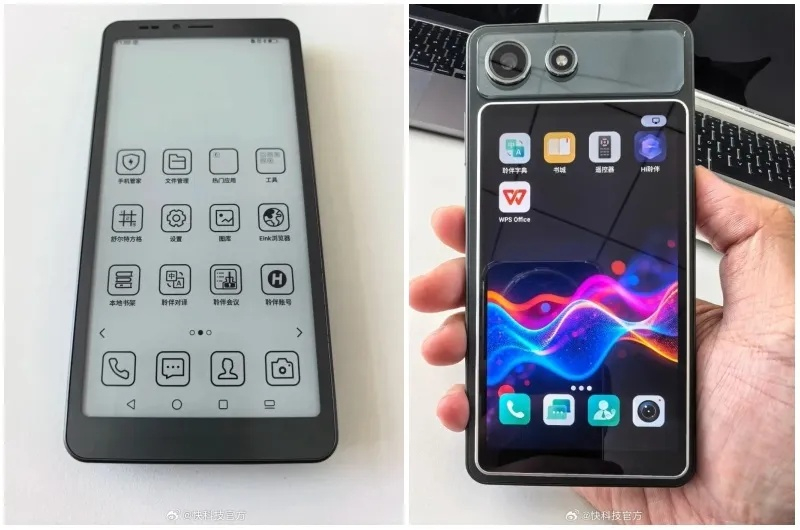
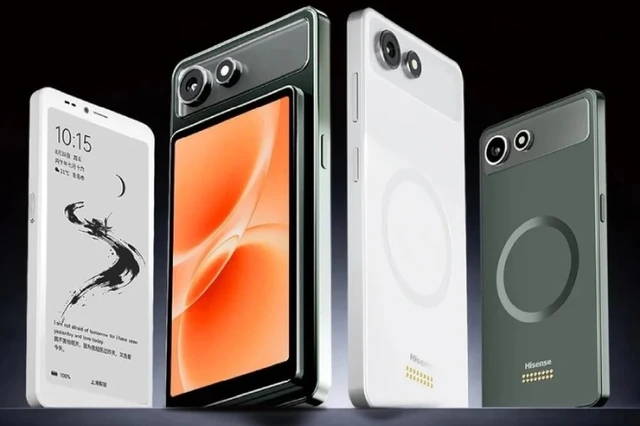
However, the series' primary innovation is its modular approach to visualization. Recognizing the inherent limitations of electronic ink when handling dynamic content, Hisense has introduced a supplementary 4.96-inch LCD screen. This panel attaches to the rear of the chassis via a magnetic ring and dedicated contact pins. This transforms the device into a hybrid: when a user needs to watch a video, examine a color chart, or browse social media, they simply switch to the color module. In the Ultra model, this screen is included as standard, whereas in the Pro version, it is offered as an optional accessory.
Powering these devices is the Qualcomm QCM6690 platform, built on a cutting-edge 4-nanometer fabrication process. This chipset does more than just provide 5G connectivity; it is deeply optimized for the specific requirements of E-ink. An intelligent power-scaling mechanism has been implemented: during static reading, processor frequencies are automatically throttled, reducing energy consumption to an absolute minimum.
The software layer is designed with an open philosophy. The smartphones run on Android 16, and unlike many competitors in the E-ink segment, Hisense imposes no restrictions on the installation of third-party software. Users gain access to a comprehensive application ecosystem, evolving the device from a specialized "e-reader" into a fully functional productivity tool.
The hardware specifications are well-balanced for productivity. A 48 MP main camera and an 8 MP front-facing module handle essential photography tasks, while the inclusion of NFC, an infrared port, and Wi-Fi 6 support ensures the device remains relevant in a modern urban environment. Power is supplied by a 4000 mAh battery. Support for 18W wired and 15W wireless charging (with magnetic standard support in the Ultra version) ensures the device remains operational without prolonged downtime.
The lineup is available in an understated color palette: "Moon White" and "Bamboo Green." Pricing varies based on memory configuration. The A10 Pro starts at 2,799 yuan ($416) for the 8/128 GB version and reaches 3,499 yuan ($521) for the top-tier 12/512 GB variant. The Ultra model, which includes the color display, is priced between 3,198 yuan ($476) and 3,898 yuan ($580) for the maximum memory configuration.
 Sparkle TCX-280DF Mobile Workstation