The global CPU market is currently navigating a period of profound structural transformation, where legacy consumption cycles are colliding with new technological imperatives. While the consumer segment remains characterized by cautious dynamics, server infrastructure is experiencing a true renaissance. The primary catalyst for this upheaval has been the meteoric ascent of generative AI, which has fundamentally rewritten the hierarchy of demand. Concurrently, the definitive migration of the user experience toward mobility is reshaping the entire hardware supply landscape.
An analysis of Q2 market metrics reveals a stark dichotomy between the client and server segments. While shipments of processors for personal computers saw a marginal year-over-year decline of 1.1%, the server market demonstrated an impressive growth of 22%. However, a closer examination reveals that the overarching trend remains bullish: sequential growth in the client sector reached 9.4%, while the server sector grew by 8%.
Consumer preferences have undergone a definitive transformation, cementing a broader shift toward mobility. Mobile processors now command 78% of the client segment, leaving desktop solutions with a mere 22%. For comparison, the balance was more distributed a year ago, standing at 71% versus 29%. This shift indicates that laptops and portable systems have virtually displaced stationary PCs in the mass market.
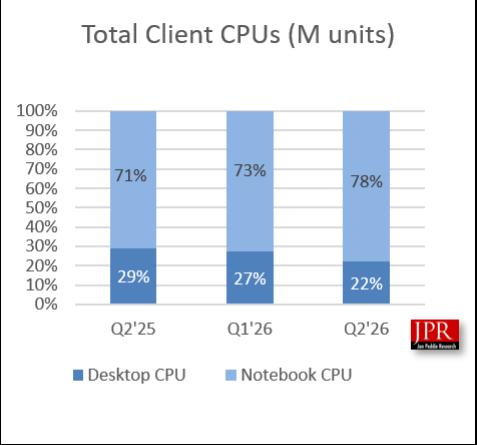
The dynamics of the second quarter were anomalous. Traditionally, this period is characterized by stagnation or even decline as vendors and retailers clear out inventory accumulated during the autumn. The current growth, however, has exceeded seasonal norms, pointing to latent demand and shifts in logistics chains. In the client segment, the temporary slowdown was triggered by external factors—primarily the rising cost of RAM and SSDs. Power users and gamers, anticipating price hikes for components, upgraded their systems late last year, creating a temporary demand vacuum in the current period.
The server segment tells a different story: a veritable boom fueled by the expansion of artificial intelligence. This trend has become a powerful growth driver for both Intel and AMD. Intel has managed to significantly strengthen its position, increasing its share of the x86 processor market from 27% to 33.4%. This rapid surge was made possible by the implementation of cutting-edge fabrication processes, specifically the success of solutions based on the Intel 18A node.
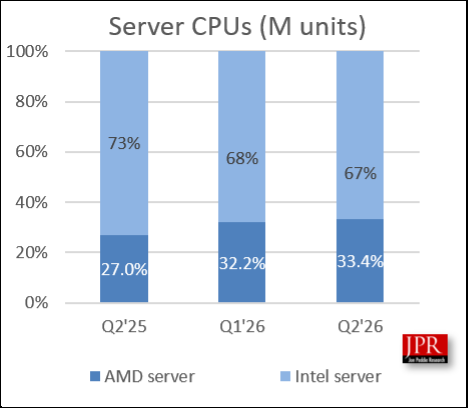
While AMD's server market share nominally contracted from 73% to 67%, the company did not emerge as the loser. In reality, AMD recorded growth in both shipment volumes and revenue, confirming a general market expansion where a growing "pie" allows for increased profits even amidst a decline in relative share.
Intel also benefited from the effect of pent-up demand. Component shortages in the first quarter forced clients to accumulate orders that were finally fulfilled in Q2, creating a spike in shipments. Simultaneously, the rollout of the Panther Lake processor family allowed the company to increase the average selling price (ASP) per unit, positively impacting the financial performance of the client division. Nevertheless, the server market continues to experience capacity shortages, signaling sustained high demand for high-performance computing.
 The Escalating Cost of AI Infrastructure