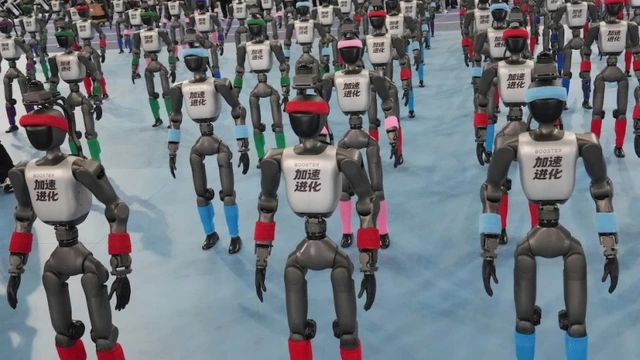
The race to develop general-purpose humanoid robots has migrated from the confines of private laboratories to the public stage of competitive arenas. The World Humanoid Robot Games have launched in Beijing, subjecting these machines to rigorous stress tests in environments designed to mirror real-world conditions. While headlines may scream about shattered athletic records, the true battle is being fought over precision manipulation and cognitive autonomy. This event signals a pivotal shift: the transition from mere showcase prototypes to the engineering of functional tools for the industrial sector.
Modern robotics has reached a pivotal inflection point where the physical capabilities of machines are beginning to transcend human limits. At recent competitions in Beijing, two androids managed to clock a 100-meter sprint faster than the legendary benchmark set by Usain Bolt, recording a time under 9.58 seconds. The pace of progress is staggering: only a year ago, the winners required over 20 seconds to cover the same distance. A similar triumph was mirrored in the 400-meter dash, where robots completed the course in 39.7 seconds, comfortably eclipsing the current world record of 43.03 seconds.
However, beneath the superficial spectacle lie fundamental engineering hurdles. These blistering speeds have laid bare a critical deficiency in control systems: the problem of deceleration. Unable to dissipate their momentum in time, the machines literally collided with the safety mats beyond the finish line. This incident underscores the widening gap between the ability to generate raw power and the capacity to manage it with precision.
Beyond kinetics, energy efficiency has emerged as a formidable challenge. The intensity of the competition forced developers to rethink their approaches to battery management and thermal dissipation. Under high-load conditions, component overheating becomes the primary bottleneck for performance—a factor of critical importance for industrial applications, where reliability and extended duty cycles are paramount.
The event program, comprising 51 disciplines, is divided between athletic competitions and situational simulations. Notably, over 40% of all trials require full autonomy, shifting the discourse from the paradigm of "remote operation" to that of genuine artificial intelligence. Athletic achievements, such as weightlifting or tug-of-war, serve merely as a technical showcase. The true value lies in the scenarios simulating work in offices, restaurants, and emergency zones.
The most telling tests were those involving interaction with an "imperfect world." A robot's ability to recognize a cable lying at an awkward angle or to adjust its gait after a missed step speaks to the evolution of computer vision and haptic feedback systems. These tests evaluate the machine's ability to precisely position its limbs, apply controlled force, and, most crucially, autonomously recover from an error without operator intervention.
From an industry perspective, the ability to run and jump does not, in itself, create economic viability. The real value of humanoid systems is realized only at the point of deployment. This includes complex tasks such as electric vehicle charging, industrial assembly, and logistical material handling—processes that require a synthesis of mechanical robustness, visual acuity, and precision force control.
The trajectory of the industry is further illustrated by the ambitious approach of startups like Galbot, which plan to move the android rivalry into the arena of tennis. Organizing singles and doubles matches between autonomous machines will serve as the ultimate test of coordination, reaction speed, and strategic thinking within a highly dynamic environment. Consequently, the games in Beijing are more than just a sporting spectacle; they are a comprehensive stress test for technologies that may soon redefine the landscape of global manufacturing.
 The Escalating Cost of AI Infrastructure