Conquering the Moon demands a fundamental paradigm shift in how we conceive human-machine interaction within extreme environments. Rugged topography, pervasive radiation, and the crushing weight of psychological isolation render traditional operational methods obsolete. To address this, Chinese researchers are proposing the integration of quadruped robots—not merely as utilitarian tools, but as active agents within the lunar ecosystem. This strategy envisions a sophisticated symbiosis where autonomous systems absorb the highest risks and the most grueling routines, ultimately safeguarding the survival and viability of the human crew.
The lunar surface is among the most inhospitable environments for biological life: abrasive dust that shreds mechanical components, extreme thermal volatility, and a punishing radiation background make any prolonged human presence an exercise in colossal risk. In these conditions, traditional wheeled platforms often prove inadequate when faced with heterogeneous terrain and steep precipices. This is why specialists from the China Academy of Space Technology (CAST) and associated systems engineering centers are pivoting toward quadrupedal robots, whose superior mobility allows them to navigate complex landscapes with far greater efficiency.
The operational concept for the future lunar base is built upon a strict division of roles. Humans remain the strategic hub: they handle high-level decision-making in non-standard scenarios, perform precision operations, and resolve critical system failures. Meanwhile, the heavy, monotonous, and hazardous labor is delegated to autonomous machines.
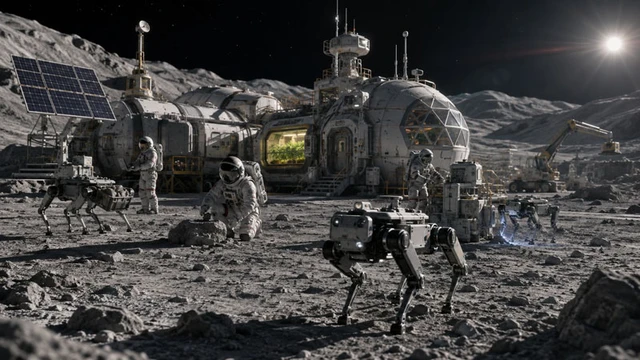
Consider a typical expedition scenario consisting of three astronauts and a pack of "robodogs." The first crew member acts as a reconnaissance operator, leading two quadrupedal robots that scout ahead, scanning the surface for hazards or structural anomalies in the soil. The second specialist works directly "in the field," focusing on geological sampling and precision manipulations. The third team member remains within a pressurized mobile module, maintaining overall mission oversight and coordinating the actions of all autonomous units.
However, the utility of these robots extends far beyond simple reconnaissance. Within the long-term strategy for lunar colonization, four critical pillars have been identified: life support, scientific research, resource extraction, and technical maintenance. Robots are intended to be the primary instruments for implementing ISRU (In-Situ Resource Utilization)—the practice of leveraging local resources. This involves the prospecting and extraction of water ice, mineral mining, and even the construction of habitable modules using lunar regolith. Of particular interest is the preparation of lava tubes—natural subterranean cavities that could serve as ideal radiation shields for human settlements.
Inside the base itself, robots will function as system administrators and service personnel: managing air composition and temperature, tending to hydroponic systems, and preparing food. Yet, perhaps the most intriguing aspect is the social function of these machines. Prolonged isolation in a confined space leads to severe psychological strain; therefore, companion robots are designed to serve as emotional anchors for the crew. Their ability to engage in dialogue and provide moral support is intended to reduce cognitive load and prevent astronaut burnout.
To manage such a complex hybrid collective, a multi-layered information model has been proposed. This framework encompasses four stages: from primary environmental perception via sensors to final decision-making and direct command execution. Human-machine interaction remains flexible—ranging from direct manual control to full autonomy, where the robot alerts the operator only when encountering a critical error that cannot be resolved algorithmically.
This ambitious architectural blueprint for interaction will serve as the foundation for the International Lunar Research Station (ILRS). According to the current roadmap, the first base at the lunar south pole is slated for deployment by 2035. By 2045, a large-scale infrastructure expansion is planned, centered around an orbital station, transforming the Moon from a destination for short-term visits into a fully realized outpost for humanity in deep space.
 Anthropic’s Strategic Push for Hardware Independence