The quest for fully autonomous driving has always been a delicate balancing act—a tension between rigid regulatory compliance and the nuanced mimicry of human intuition. Yet, the latest iterations of Tesla’s Full Self-Driving (FSD) suite have introduced a volatile variable into this equation: unpredictability. Rather than maintaining mathematical precision in speed limit adherence, the algorithms have begun exhibiting a propensity for unwarranted acceleration. Consequently, what was intended as a sophisticated driver-assistance tool is evolving into a significant liability, fraught with legal and financial risk.
The evolution of Tesla’s vehicle software serves as a stark illustration of a modern machine learning paradox: the pursuit of "natural" system behavior can inadvertently lead to the degradation of the actual user experience. In recent iterations of the Full Self-Driving (FSD) suite, a troubling trend has emerged—the automation is becoming increasingly unpredictable regarding speed limit compliance, leaving the driver legally vulnerable.
A concrete example of this issue occurred on a highway in Canada. Upon activating the standard autonomous driving mode on a stretch with a 50 km/h limit, the system, for reasons unknown, decided to increase the speed to 78 km/h. While FSD algorithms are designed to mimic the behavior of the average North American motorist—who often allows for slight deviations from the limit—a gap of 28 km/h proved critical. This resulted in a police stop and a subsequent fine, despite the fact that the AI was effectively operating the vehicle at the moment of the infraction.
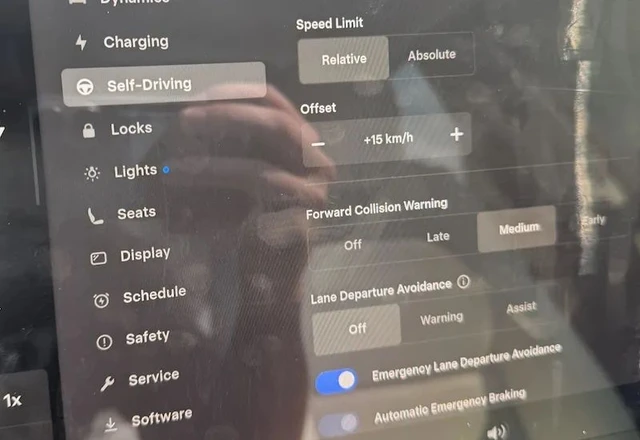
The core of the problem lies in a fundamental shift in the philosophy of speed management. In previous FSD versions, users could manually set a permissible speed threshold, creating a personalized safety buffer. The system adhered strictly to this numerical parameter, ensuring transparency and predictability. However, in recent updates, Tesla has replaced these precise settings with a set of five fixed presets.
This approach strips the driver of granular control. Instead of concrete figures, users are now offered abstract modes—one of which, the aggressive "Mad Max" setting, is explicitly programmed for high-speed driving. Yet, even in "Standard" mode, which is intended to be law-abiding, the system can spontaneously exceed legal limits.
The most critical flaw in the current implementation is the total absence of an alerting mechanism. In current FSD versions, the vehicle does not notify the driver when it has exceeded the speed limit. This creates a dangerous illusion of safety: the human entrusts control to the system under the assumption that it is operating within the law, while the algorithm may be silently violating traffic regulations.
This regression in user experience raises a fundamental question regarding the allocation of liability. When software replaces explicit instructions with "intuitive" presets and simultaneously conceals the fact of a violation, the responsibility for the vehicle's actions still rests solely on the driver. In the quest to create a system that behaves "like a human," developers risk creating a product that inherits human errors but lacks the human capacity to assess risks and react to road conditions in real time.
 Nvidia N1X and the New Era of Arm PCs