The original PlayStation fundamentally shaped the gaming landscape of the nineties, yet its technical ceiling was always rigidly defined. For decades, the 2MB RAM limit was regarded as an immutable constant for the home systems of that era. However, a recent engineering experiment pushing the memory capacity to 16MB is now challenging these legacy dogmas. This project vividly illustrates the dramatic disconnect between the latent potential of the hardware and the restrictive software architecture of the early 3D epoch.
The legacy of modifying the original PlayStation has long been a struggle against the rigid hardware constraints that once dictated the very boundaries of game design. For years, the "holy grail" for modders was expanding the system memory to 8 MB; however, recent research has pushed the envelope even further. This new technical breakthrough stems from an analysis of PlayStation-based arcade boards, which utilized significantly more powerful memory configurations. By studying these architectures, an enthusiast concluded that the retail console's CPU is capable of addressing a far larger volume of data than factory specifications ever suggested.
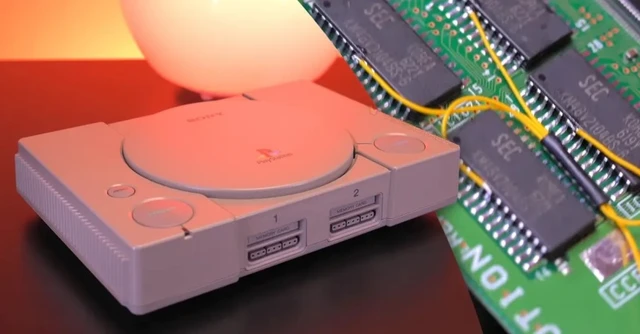
Bringing this vision to fruition required invasive hardware surgery. The project utilized a console equipped with the PU-18 motherboard as its foundation. The primary objective was the replacement of the four stock 512 KB EDO DRAM chips. In their place, the modder installed 2 MB chips salvaged from legacy PC memory modules.
The primary engineering challenge was spatial: four chips were soldered directly to the board, with another four stacked atop them in two layers. To manage this memory array correctly, a sophisticated workaround was employed involving the seventh pin of the upper chips; by leaving it disconnected, the modder was able to reroute the selection signals for the second memory block. Additionally, a specialized QSB board was integrated into the system, linked to the motherboard via a series of jumpers.
Yet, such ambitious upgrades are colliding with a critical bottleneck: the scarcity of components. Production of EDO DRAM ceased decades ago, and as the modding community grows, sourcing compatible 2 MB chips is becoming increasingly difficult. This transforms such experiments from a simple hobby into a form of "digital archaeology."
While the modified hardware successfully passed functional tests, the project exposed a fundamental friction point in retro-gaming: the software barrier. The vast majority of PlayStation 1 titles were developed with a hard-coded dependency on 2 MB of RAM. The software simply cannot "see" the additional overhead, as memory addressing was baked into the game engines at the assembly level.
The empirical results have been mixed. In several instances, the memory surplus actually triggers instability; for example, Final Fantasy IX freezes at the loading screen, unable to reconcile the altered system configuration. The sole exceptions are titles for which the community has already developed specialized patches for 8 MB configurations—in these cases, there is a noticeable improvement in stability or visual quality.
Ultimately, expanding the memory to 16 MB stands more as a triumph of engineering ingenuity than a practical enhancement. Even if the software could leverage this capacity, the GPU would become the primary bottleneck, as it is not designed to handle the increased data throughput, potentially leading to performance degradation. This experiment serves as a poignant reminder that in the realm of legacy hardware, software code is a more immutable law than the physical capabilities of silicon.
 MSI Katana 15 HX and the Memory Paradox