The Moon is once again emerging as the epicenter of a global geopolitical struggle. In a bid to cement its leadership in space exploration, NASA is pivoting from transient missions toward the establishment of a comprehensive infrastructure for a permanent lunar presence. By leveraging the commercial sector, the agency aims to accelerate the deployment of bases across the Moon's most strategically critical regions. This is no longer merely a scientific endeavor; it is a race for the resources that will define the architecture of a future interplanetary economy.
The United States is formally scaling its lunar ambitions, securing a series of new contracts aimed at a late 2028 horizon. Under the Commercial Lunar Payload Services (CLPS) program, NASA is investing nearly $600 million into four autonomous missions—a move that signals a strategic pivot from preliminary technology demonstrations to the systematic rollout of lunar infrastructure. The primary contractors are industry veterans well-acquainted with the volatility of lunar operations: Astrobotic, Intuitive Machines, and Firefly Aerospace. The allocation of funds reflects the scale of the objectives: Astrobotic will receive $297.9 million for two delivery missions, while Intuitive Machines and Firefly Aerospace will split the remainder, executing one mission each.
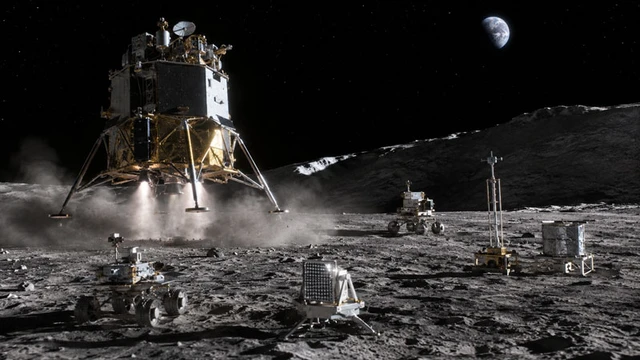
The strategic focal point of these efforts is the lunar South Pole. This region is of paramount interest due to its "permanently shadowed regions" (PSRs), where scientists believe significant deposits of water ice reside. In the context of long-term space exploration, water is far more than a life-support resource; it is the essential feedstock for producing oxygen and rocket propellant. Consequently, establishing a presence at the South Pole is effectively securing a "refueling hub" for future leaps into deep space. By 2029, NASA intends to radically accelerate its expansion, orchestrating up to 25 missions, including 21 landings. This massive deployment of autonomous probes, relay satellites, and power systems is designed to lay the foundation for a future inhabited base.
To ensure the safety and precision of these operations, each new mission will be equipped with a specialized instrumentation suite. First is the SCALPSS complex—a four-camera system designed to analyze the impact of engine plumes on the lunar regolith. Understanding how dust is displaced during descent is critical to preventing damage to existing equipment when heavier transport vehicles eventually touch down.
The second component is the LRA, a passive laser retroreflector array composed of quartz reflectors. This will serve as a high-precision navigational beacon, allowing orbital and landing craft to determine their coordinates with minimal margin of error. Completing the payload is the LETS spectrometer, tasked with monitoring the radiation environment. Precise data on particle types and energy levels will enable engineers to design robust shielding for future crews, mitigating health risks for astronauts.
Beyond targeted deliveries, NASA is developing more integrated engineering frameworks. Plans include the launch of the PROMISE rover—a hybrid vehicle that synthesizes the architectural legacies of the Curiosity and Perseverance Mars rovers. This approach allows NASA to transpose proven Martian technologies for autonomous navigation and soil analysis into the lunar gravity environment. Parallel to this, a comprehensive communication and navigation network is being deployed, alongside the testing of advanced avionics and power systems essential for the autonomous functioning of a lunar base.
However, the road to success remains fraught with challenges. The history of commercial lunar landings has so far been a series of costly learning curves: Astrobotic modules have suffered catastrophic failures, and Intuitive Machines' craft have shown a tendency to tip upon contact with the surface. To date, Firefly Aerospace has provided the most stable results. Nevertheless, in the aerospace industry, failure is often more instructive than accidental success. By utilizing upgraded versions of previously flown platforms, NASA is betting on iterative development, where every setback becomes a stepping stone toward a reliable, industrial-grade transport system.
 Taiwan's Space Program: The First Major Milestone