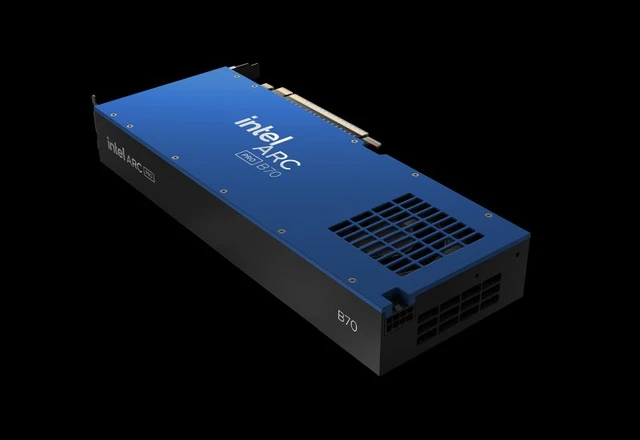
The market for specialized graphics accelerators has been hit by a wave of volatility that defies the logic of standard sales cycles. The Intel Arc Pro B70 series, launched this spring, has seen an anomalous price surge within a single month. This trend is primarily driven by a global memory shortage coupled with an exploding demand for AI-driven workloads. The situation serves as a stark reminder of how heavily the pricing of end-user hardware is now tethered to the availability of critical components.
The Intel Arc Pro B70 lineup made its debut in March, and by the standards of today's rapid technological cycles, these devices are still cutting-edge. However, the "honeymoon period" of accessible pricing proved short-lived. While the newcomer launched in the spring at $949 and long held steady below the $1,000 psychological barrier, current market dynamics have triggered a price surge of 26% to 46%.
Price hikes are unevenly distributed yet ubiquitous. In the US, where conditions are traditionally most favorable, the cost of the graphics card skyrocketed from $999 to $1,299 within a single month. Meanwhile, reference designs from the manufacturer themselves can reach $1,779 in US retail, signaling a severe disconnect between recommended pricing and actual market availability.
The European market has shown a slightly more tempered, yet still concerning, trajectory. The average cost of the device climbed from €1,200 to €1,500. Although the percentage increase here was lower than in the US, the starting price in Europe was higher to begin with, making the final cost quite substantial for the professional user.
The most volatile situation has unfolded in South Korea. In mid-July, the card was still available for $1,334, but by mid-August, the price jumped to $1,975—an increase of nearly 46%. Paradoxically, even with such a spike, retail prices remain slightly below the $1,988 MSRP that Intel established for its partners in the local market.
The driver behind this pricing volatility lies in the model's technical specifications. The Intel Arc Pro B70 boasts a substantial 32 GB of GDDR6 video memory. Critically, it features Error Correction Code (ECC), which transforms a standard graphics accelerator into a full-fledged computational tool for workstations, where data stability takes precedence over raw rendering speed.
Amidst the global surge in generative AI, such devices have become highly coveted. The ability to leverage GPUs for neural network acceleration, combined with the record-breaking rise in memory costs, has created a "perfect storm." Consequently, a professional tool designed for stability has become a scarce resource, with its price dictated not by the vendor's marketing strategy, but by the physical scarcity of components in warehouses.
 The Price of Acceleration: CXMT’s Rapid Push into Memory