Modern machine learning and generative AI workloads are rapidly migrating from cloud servers to local workstations. This shift has triggered an unprecedented demand for stable, high-efficiency power delivery capable of weathering the extreme transient spikes generated by multi-GPU configurations. Gigabyte meets this challenge with the Aorus P1600W—a unit where precision engineering converges with granular digital control. More than just a power source, this PSU evolves into a comprehensive monitoring node for high-performance computing environments.
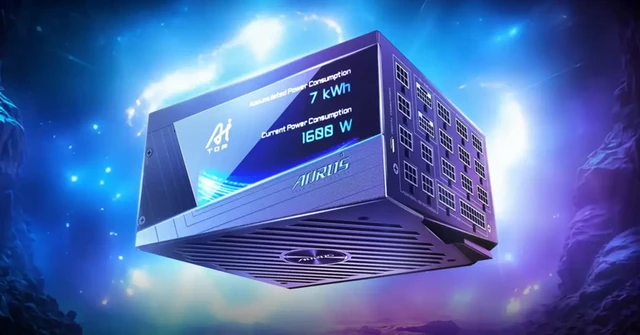
The "AI TOP" moniker in the Aorus P1600W power supply might mislead those expecting an onboard NPU or intelligent controller. In reality, it signifies rigorous validation for specialized workloads: the sustained, intensive computations typical of local Large Language Model (LLM) deployment and neural network training. Integration with the eponymous AI TOP utility transforms the PSU into an active monitoring element, allowing users to track power consumption in real-time during AI model operations.
The unit's technical foundation rests on ATX 3.1 and PCIe 5.1 standards, ensuring full compatibility with the latest hardware. Particular emphasis has been placed on power excursion resilience; the system is engineered to handle peak loads reaching three times the GPU's nominal rating and double the overall system load. An 80 Plus Titanium certification underscores its exceptional energy conversion efficiency—up to 94%—a critical factor when managing power at this scale.
To achieve high power density and optimize internal spatial efficiency, Gigabyte has implemented Gallium Nitride (GaN) MOSFETs. The transition to GaN significantly reduces thermal output and shrinks component footprints compared to traditional silicon-based solutions, allowing 1600W of capacity to be housed in a relatively compact 150 × 160 × 86 mm chassis. System reliability is underpinned by premium Japanese capacitors and digital power circuitry featuring a single +12V rail.
Power delivery to graphics accelerators is handled with maximum flexibility. The unit features two native 12V-2×6 connectors, each capable of delivering up to 600W. Additionally, adapter cables are provided to bridge 8-pin connectors to the 12+4 pin standard. This configuration enables the powering of up to four GPUs (up to 300W each), effectively transforming the setup into a full-fledged compute workstation.
The visual and functional centerpiece is the integrated Edge View LCD. It displays critical telemetry: real-time output power, voltage, component temperatures, and fan speeds. In multi-processor configurations, this screen serves as a vivid indicator of how rapidly power consumption climbs into four-digit figures. For personalization, the interface supports custom video playback.
Thermal management is handled by a 140mm dual ball bearing fan. The cooling system operates in a semi-passive mode, engaging only when necessary. A notable engineering touch is the reverse rotation function: the fan can briefly invert its blade direction during startup or via software command to effectively purge accumulated dust from the heatsinks and internal components, extending the unit's operational lifespan.
 Breaking the Lithography Barrier in China