The global mobile processor market is undergoing a profound transformation, as established incumbents begin to lose their grip on the industry. The decline in overall chip shipments signals more than just a temporary dip in demand; it points to a fundamental shift in the paradigm of modern smartphone manufacturing. Vertical integration has moved to the forefront, enabling tech giants to develop proprietary, specialized silicon tailored to their specific needs. Driving this evolution is the meteoric rise of artificial intelligence and intensifying economic pressures stemming from the memory market.
The first half of 2026 was marked by a distinct cooling trend across the mobile computing sector, with overall processor shipments contracting by 15% year-over-year. However, beneath this figure lies a more complex redistribution of power. The market's traditional incumbents—MediaTek and Qualcomm—have faced a palpable decline in performance. MediaTek’s market share corrected from 37% to 32%, while Qualcomm saw its presence erode, slipping from 26% to 22%. Collectively, sales for these two giants have plummeted by more than a quarter, signaling the erosion of their long-standing market dominance.
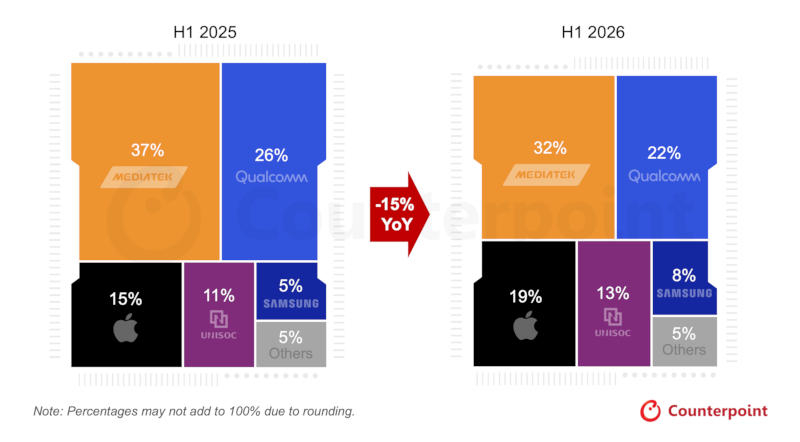
While general-purpose vendors lose ground, there is a steady ascent of players betting on proprietary development and highly specialized solutions. Apple, Samsung, Google, and Unisoc are demonstrating positive momentum, confirming a global shift toward closed ecosystems. Android OEMs are increasingly pursuing autonomy, designing silicon that is meticulously optimized for their own software stacks and hardware architectures.
The economic backdrop of this shift is driven by an unexpected catalyst: a critical shortage and skyrocketing costs for memory chips. Memory prices have surged approximately 300% year-over-year, radically altering the cost structure of the modern smartphone. In this new reality, the central processor is no longer the primary driver of device pricing; the financial burden has shifted to memory modules, forcing vendors to recalibrate their pricing strategies and seek new ways to enhance consumer value.
The industry's response to this challenge has been the meteoric rise of AI accelerators. Despite the general market downturn, demand for chips with integrated AI capabilities grew by 24%. A prime example is the Google Tensor G5, which pivots away from raw compute power in favor of intelligent functionality and machine learning. This trend defines the current evolutionary vector for the entire industry: processors are evolving from simple "calculators" into sophisticated neuromorphic systems.
The trajectory of this rivalry will be determined by the upcoming release cycle. Expectations are high for Google’s Pixel 11 series, powered by the new Tensor G6, which is poised to be an even more autonomous and efficient tool for AI workloads. Simultaneously, Samsung continues to evolve its Exynos line, albeit with a cautious deployment strategy—for instance, in the current foldable series, the proprietary chip was reserved exclusively for the entry-level Galaxy Z Flip8. Such a strategy suggests a period of calibration, as manufacturers seek the ideal equilibrium between proprietary innovation and proven third-party solutions.

 The Environmental Toll of U.S. Technological Leadership