The evolution of graphics technology is pivoting from basic frame interpolation toward deep neural rendering, imposing unprecedented demands on hardware. With the arrival of the RTX 50 series, the industry is confronting a new challenge: a massive surge in power consumption triggered by the activation of advanced AI algorithms. Early benchmarks of DLSS 5 reveal that the technology can push flagship GPUs to their absolute electrical and thermal limits. Consequently, a tool designed for performance enhancement has effectively evolved into a rigorous stress test for the most powerful hardware on the market.
The current era of GPU evolution is defined by a shift toward full-scale neural rendering, where artificial intelligence assumes a significant portion of the computational workload. However, this leap in image quality comes at a steep price: power consumption. Recent benchmarks utilizing the OptiScaler community implementation of DLSS 5 reveal that the flagship GeForce RTX 5090 is pushed to extreme limits when neural networks operate at full capacity.
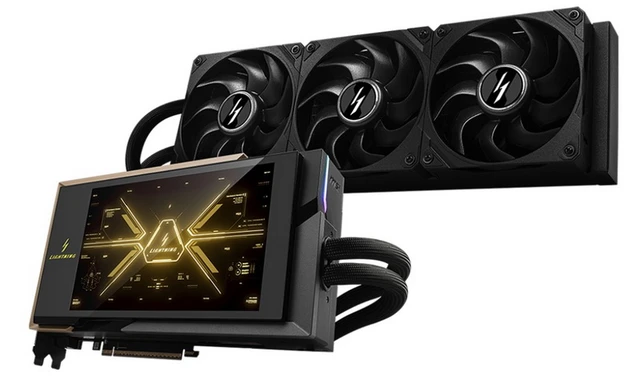
The gap between reference designs and custom AIB models becomes critical during these peaks. While the Founders Edition adheres to its stated 575W limit, modified versions—such as the MSI GeForce RTX 5090 Lightning Z—exhibit far more aggressive behavior. Thanks to an expanded power limit embedded in the vBIOS, this card can draw significantly more power, allowing it to maintain higher frame rates at the cost of massive thermal output.
Practical tests in Cyberpunk 2077, utilizing 4K Path Tracing with the Performance profile, revealed a concerning trend. Power draw for the reference RTX 5090 climbed from 482W to 551W, while the Lightning Z surged from 580W to 723W—an increase of approximately 25%. Paradoxically, despite this spike in consumption, in-game performance dropped by nearly 40%. This suggests that the current software implementation of neural rendering introduces immense computational overhead that, for now, is not offset by a gain in FPS.
A similar pattern emerges in Hogwarts Legacy. During peak loads, the MSI Lightning Z shows a power spike of 240W, representing a 50% increase in power draw. Meanwhile, performance degradation on the reference card reached 49%, underscoring the sheer computational weight of DLSS 5 algorithms on current hardware.
The most telling results came from Control. Here, the MSI Lightning Z hit 802W, effectively turning the GPU into an industrial space heater. In this scenario, the Founders Edition simply hit its hard cap of 575W. Despite the overall performance loss, the high-power-limit model still delivered 20% more frames per second than the standard version, confirming a direct correlation between neural rendering efficiency and the available power budget.
The MSI Lightning Z's hardware configuration—featuring dual 12V-2x6 power connectors and a rated ceiling of 1000W—allows it to operate where standard solutions begin to throttle or downclock. While some experts speculated that a single power connector might become a bottleneck for DLSS 5, these tests suggest that the technology simply demands a massive power reserve to keep Tensor cores running efficiently.
Consequently, DLSS 5 is evolving beyond a mere upscaling method into a comprehensive stress test for power delivery and cooling systems. In the future, such technologies may become the primary benchmark for selecting high-end GPUs, where the deciding factor will not be raw chip performance, but rather the power system's ability to handle brief but extreme power transients.
 The Horizon of China's Technological Sovereignty in Lithography