For years, the item-tracking market has been the domain of walled gardens, with Apple defining the benchmarks for precision and user experience. Google is now challenging this hegemony with the introduction of the Pixel Tag—a device engineered to unify the fragmented Android landscape under a singular positioning standard. Far from being just another peripheral, the Pixel Tag represents a strategic push toward comprehensive spatial awareness, integrated seamlessly across both hardware and software. Under the hood, it leverages technologies that redefine our fundamental approach to locating misplaced items.
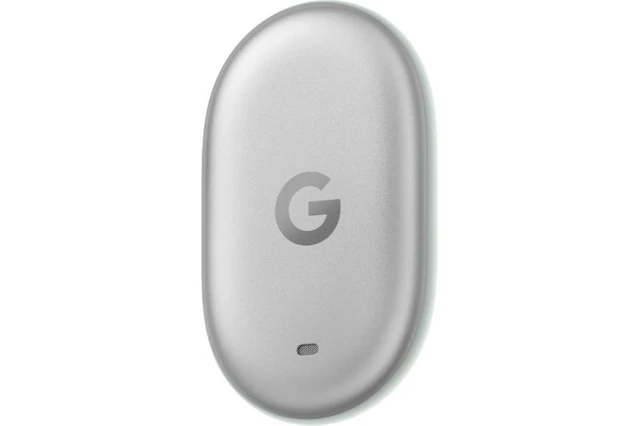
Seeking to establish a formidable rival to the AirTag, Google has unveiled the Pixel Tag—a compact device that blends austere industrial design with cutting-edge data transmission protocols. The chassis is crafted from a combination of metal and polycarbonate, striking an optimal balance between durability and lightness: measuring 28 × 46.1 × 5.4 mm, the device weighs just 11.8 grams including the power source. This practicality is bolstered by an IP67 rating, ensuring resilience against accidental submersion in water up to one meter—a critical feature for the rigors of daily use.
The Pixel Tag's technical architecture is engineered for maximum spatial precision. The primary interface is Bluetooth, now enhanced by the innovative Channel Sounding technology. Unlike traditional distance estimation based on signal strength (RSSI), which is often prone to inaccuracies caused by physical obstructions, Channel Sounding analyzes signal phase shifts to determine the distance between the smartphone and the tracker with significantly higher accuracy. For the final stage of recovery, the device leverages Ultra-Wideband (UWB) connectivity to power "Precision Finding." This allows users to visually track the exact direction of their object on-screen within a radius of up to 50 meters.
However, unlocking this full potential necessitates deep OS integration. To utilize all positioning features, Android 16 and Bluetooth 6.0 support are required, underscoring Google's strategy of synchronizing hardware evolution with the latest iterations of its software. That said, baseline compatibility remains: the device will function with smartphones running Android 9 and above, albeit with a reduced feature set.
Internally, the Pixel Tag is optimized for both autonomy and utility. An integrated accelerometer handles motion detection, while a built-in speaker enables acoustic localization, allowing users to find the device via audio cues in low-visibility environments. Power is supplied by a standard CR2032 lithium battery. According to specifications, a single cell should provide over a year of operation, though actual longevity will fluctuate based on UWB utilization and environmental conditions.
Ultimately, the Pixel Tag serves as a critical cornerstone of the Google ecosystem, offering Android users a level of asset management and control that was previously the exclusive domain of Apple device owners.
 The Evolution of Apple's Augmented Reality Ecosystem