In the computer hardware industry, platform lifecycles are typically fleeting, spanning only a few years before users are coerced into expensive hardware migrations. AMD’s Socket AM4, however, stands as a rare anomaly, exhibiting remarkable longevity and adaptability for nearly a decade. The debut of the ASRock B550 Rock WiFi motherboard underscores that this ecosystem remains capable of delivering relevant and competitive solutions. Consequently, what was once a legacy standard has evolved into a rock-solid foundation for contemporary builds centered on pragmatism and efficiency.
The history of Socket AM4 is something of an anomaly in the world of consumer electronics. Debuting in 2016 with the Bristol Ridge processors, this socket became the foundation for the legendary Ryzen lineup, which fundamentally redefined the landscape of multi-threaded computing. While competitors frequently cycled through sockets—forcing users to replace their motherboards with every new CPU generation—AMD adhered to a strategy of long-term platform longevity. Today, even as the industry has pivoted toward DDR5 and next-generation interfaces, AM4 persists, sustained by both fierce user loyalty and strategic moves from the manufacturer, such as the recent re-release of the iconic Ryzen 7 5800X3D gaming processor.
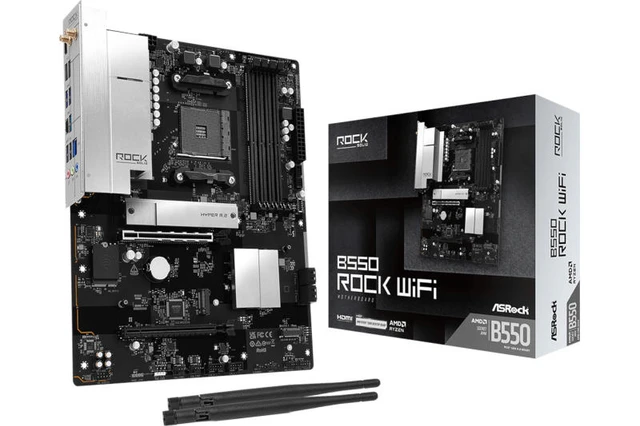
The latest offering from ASRock, the B550 Rock WiFi, is a direct response to market demand for affordable yet fully functional solutions for this enduring platform. Built in the classic ATX form factor and powered by the B550 chipset, the board targets the "sweet spot" for the majority of users. It strikes an ideal balance between cost and capability, supporting a broad spectrum of processors—from the budget-friendly 3000G and 4000G series to the high-performance 5000-series chips.
The board's technical profile is engineered with a focus on stability and overclocking. A 10-phase power delivery system ensures reliable operation even under heavy loads, which is critical for unlocking the full potential of multi-core Ryzen CPUs. Despite the emergence of newer standards, DDR4 memory continues to deliver excellent performance. The B550 Rock WiFi features four DIMM slots supporting up to 128 GB of RAM with overclocking capabilities reaching 4733 MHz and beyond, making the system well-suited for both demanding professional workloads and modern gaming.
The storage subsystem and networking capabilities merit particular attention. ASRock has implemented a tiered M.2 slot architecture, allowing for flexible PCIe resource allocation. A single Hyper M.2 slot operates on the PCIe 4.0 x4 standard, providing maximum throughput for flagship NVMe drives. Two additional slots (Ultra M.2 and a standard M.2) utilize PCIe 3.0, which remains more than sufficient for most mid-range SSDs. Additionally, four SATA III ports are provided for traditional storage drives.
In terms of connectivity, the board meets contemporary standards: Wi-Fi 6E support and a 2.5-Gigabit Realtek Ethernet adapter keep it relevant even in the era of ultra-high-speed networking. The rear I/O panel is fully equipped with all the essentials, ranging from a USB Type-C port and HDMI outputs to a full 7.1-channel audio suite powered by the Realtek ALC897 codec.
Despite its technical maturity, the B550 Rock WiFi occupies a specific market niche. Currently, the device is available in the Japanese market at a highly competitive price point of approximately $105, while a global release remains uncertain. Nevertheless, the mere existence of new AM4 products after so many years underscores the viability of the platform. It serves as proof that in an era of hyper-consumption, a quality engineering solution can remain relevant far longer than marketers ever intended.
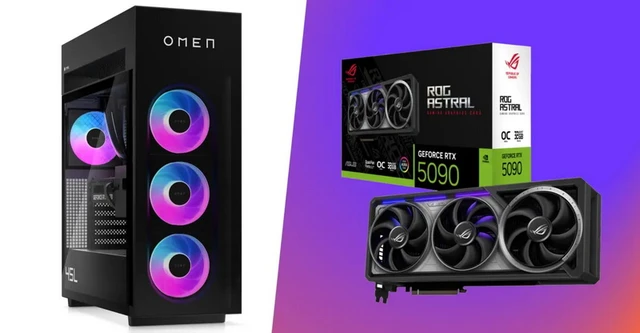 The Economic Paradox of the GeForce RTX 5090