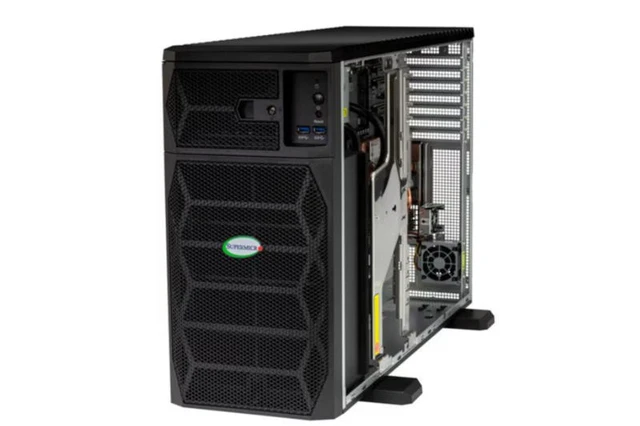
The era of local neural networks demands a fundamental reimagining of workstation capabilities. Cloud computing is no longer the sole gateway for training and deploying large-scale language models. AMD’s new Halo Station embodies this paradigm shift, fusing immense raw computing power with highly specialized accelerators. It effectively migrates the capabilities of a full-scale data center directly onto the professional's desktop.
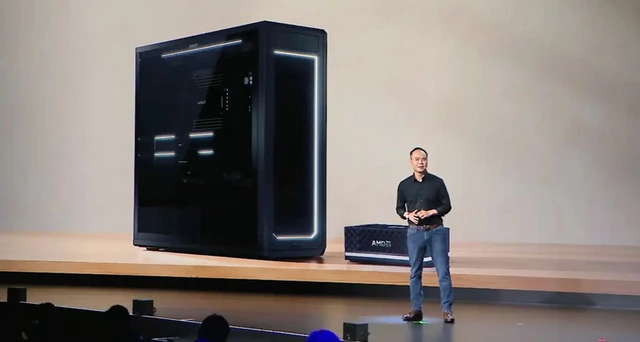
The unveiling of the Threadripper Halo Station at IFA 2026 in Berlin signals a paradigm shift in professional computing. This is not merely an evolution of the traditional workstation, but an ambitious attempt to create a standalone compute node capable of handling workloads that previously required an entire server rack. Positioned as the most powerful station on the market, every component has been engineered for maximum throughput and minimal latency when processing massive datasets.
At the heart of the system lies the Ryzen Threadripper PRO 9995WX. Built on the Zen 5 microarchitecture, this chip boasts 96 physical cores and supports 192 virtual threads. With clock speeds reaching 5.4 GHz and a staggering 384 MB of L3 cache, the processor is designed to efficiently handle multi-threaded workloads of any complexity. However, the defining factor here is not just raw power, but the data interconnect fabric: support for eight-channel DDR5 memory and 128 PCIe 5.0 lanes ensures that bottlenecks are eliminated when interacting with peripherals and accelerators.
To ensure seamless operation with gargantuan datasets, the station is equipped with 2 TB of RAM. This capacity is critical for modern machine learning tasks, where the ability to load model weights and context windows directly into system memory becomes the primary determinant of speed and stability.
The real performance breakthrough is delivered by specialized Instinct MI350P accelerators based on the CDNA 4 architecture. The base configuration features two such modules, though the system is scalable up to four. Each accelerator is equipped with 144 GB of ultra-fast HBM3E memory with bandwidth up to 4 TB/s, enabling lightning-fast data movement within the VRAM. In a maximum configuration, the total available video memory reaches 576 GB.
Particular attention should be paid to its FP4 precision performance, where a single accelerator delivers up to 4,614 TFLOPS. This specific metric makes the Halo Station an ideal tool for the local deployment and fine-tuning of Large Language Models (LLMs), allowing specialists to work with confidential data without the need to offload it to the cloud.
Such extreme power density inevitably leads to significant thermal hurdles. Given that the CPU's TDP is 350W and each accelerator consumes up to 600W, traditional cooling solutions are insufficient. The solution is an integrated liquid cooling system that maintains thermal stability even under peak loads.
From an economic perspective, the Halo Station represents a significant capital investment. While an official price list has not been released, an analysis of the components reveals the scale of the investment. A single Instinct MI350P accelerator is estimated at approximately $20,000, while the 2 TB memory array costs roughly $50,000. Adding the cost of the flagship processor (approximately $11,000–$12,000), it becomes evident that the device is targeted at a narrow segment of corporate clients and research centers for whom hardware costs are secondary to performance and data privacy.
 Nvidia N1X and the New Era of Arm PCs