Apple continues to redefine the compact workstation, blurring the boundaries between portability and raw, uncompromising performance. The transition to its latest generation of silicon signals a strategic pivot toward deep AI integration and unprecedented energy efficiency. The new Mac mini is more than a mere iterative update; it is a manifesto for local computing in the age of Large Language Models. By pairing a 2-nanometer fabrication process with cutting-edge connectivity standards, Apple has transformed this desktop into a formidable powerhouse for creators and developers alike.
The latest refresh of the Mac mini lineup introduces two distinct tiers: a base model powered by the M6 chip and a high-performance variant featuring the M5 Pro. Compared to the 2024 iterations, these devices offer more than just a bump in clock speeds; they represent a comprehensive overhaul of the data transmission infrastructure, ranging from accelerated storage to next-generation wireless protocols.
The centerpiece of this update is the debut of the M6 chip, marking Apple's first foray into the 2-nanometer process. This transition to a denser lithography allows for a significant reduction in power consumption while simultaneously driving up performance. The base M6 now utilizes 12 CPU and GPU cores—two more than its predecessor—resulting in a CPU computational leap of up to 40%.
Significant architectural refinements have been made to the graphics subsystem, with neural accelerators now integrated directly into every GPU core. Combined with an increase in unified memory bandwidth—which has jumped from 120 to 170 GB/s—the impact is palpable in demanding workloads. In Cyberpunk 2077: Ultimate Edition with active ray tracing, performance has nearly doubled compared to the M4 model. The base M6 configuration ships with 16GB of memory and a 256GB SSD, with the latter seeing a twofold increase in read/write speeds.
For professional workflows, Apple has introduced the M5 Pro model. Here, the company has maximized parallel processing capabilities: the processor can feature up to 18 CPU cores and 20 GPU cores, each further augmented by neural accelerators. Memory bandwidth reaches an impressive 307 GB/s, with a maximum capacity of 64GB.
This headroom is critical for modern AI-driven tools. In LM Studio benchmarks, the processing of Large Language Model (LLM) queries is four times faster, while rendering in Blender and workflows in Affinity showed gains between 1.4x and 1.5x. This effectively transforms the Mac mini from a simple office machine into a fully capable node for the local deployment of neural networks.
Connectivity has also seen a generational leap, powered by the specialized Apple N1 chip. Both machines now support Wi-Fi 7 and Bluetooth 6, while the baseline Ethernet standard has been upgraded from 1 Gbps to 2.5 Gbps, with an optional expansion to 10 Gbps.
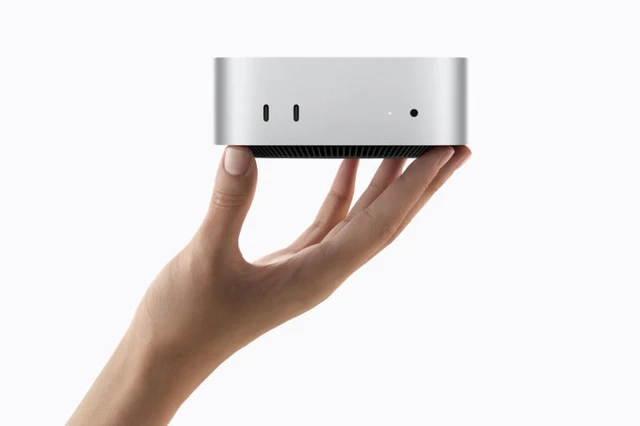
The I/O layout remains conservative yet functional. The front panel houses two USB Type-C (USB 3) ports and a headphone jack. The rear is dedicated to HDMI, Ethernet, and three Thunderbolt ports. Notably, the M5 Pro version features Thunderbolt 5, paving the way for clustering multiple Mac minis into a single compute node to run ultra-large AI models. Additionally, Genlock synchronization via USB Type-C has been implemented, a feature that will be invaluable in professional video production.
Underpinning the hardware is macOS 27 Golden Gate. The system is deeply integrated with Apple Intelligence and an updated Siri AI, evolving the operating system into a proactive intelligent assistant.
The barrier to entry has risen: the price for both models has increased by $300 over the previous generation. The base M6 version starts at $899, while the M5 Pro begins at $1,699. Despite the price hike, the technological leap in lithography and AI computation ensures these devices will remain relevant for years to come. Shipping begins September 22, with macOS 27 becoming available to all users this autumn.
 The Economic Paradox of the GeForce RTX 5090