The global surge in artificial intelligence is fundamentally rewriting the playbook for the semiconductor industry. While DRAM manufacturers were the primary beneficiaries during the initial phase, a wave of price appreciation has now swept through the NAND flash segment. The dramatic revenue spikes seen among industry leaders signal a profound structural shift in the dynamics of supply and demand. At the heart of this evolution is a strategic reallocation of resources toward high-performance solutions tailored for data centers.
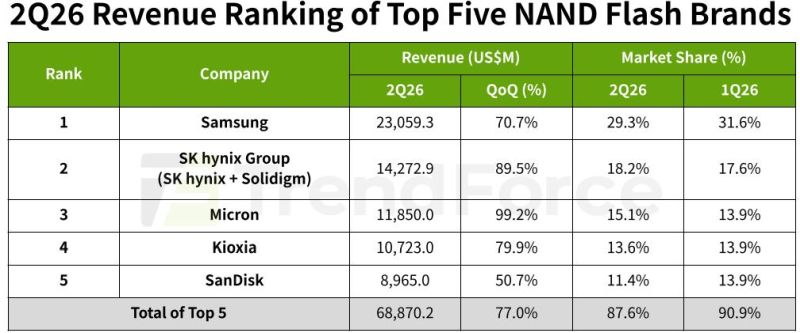
The NAND flash economy is currently in a phase of aggressive rebound. According to TrendForce analysts, the combined revenue of the five largest vendors in this segment surged by 77% last quarter, reaching $68.87 billion. This rapid momentum is driven less by growth in sales volumes and more by a substantial increase in average selling prices (ASPs) amid persistent shortages.
The market is exhibiting a fascinating divergence in demand elasticity. In the consumer segment—smartphones and PCs—buyers remain price-sensitive, and high memory costs are curbing procurement volumes. However, the server sector, where infrastructure for AI training is being deployed, tells a different story. Here, demand is virtually decoupled from price, allowing manufacturers to continue hiking costs without sacrificing volume.
The situation is further exacerbated by the internal priorities of the vendors themselves. In the pursuit of windfall profits from HBM (High Bandwidth Memory) and standard DRAM—both critical for GPUs—manufacturers are deliberately limiting investments in NAND development. Flash memory is effectively being funded as a secondary priority, creating an artificial supply deficit that further drives prices upward.
Within the "Big Five," a redistribution of power is underway. Samsung Electronics maintains its dominant position with a 29.3% market share and $23 billion in revenue, yet the company has begun to lose ground, slipping from a previous 31.6%. Meanwhile, the SK hynix and Solidigm alliance is demonstrating robust growth, with revenue climbing 89.5% to $14.3 billion and its market share rising to 18.2%.
The most impressive growth was seen in the US-based Micron Technology, which nearly doubled its financial performance to secure third place in the global rankings with a 15.1% share. Conversely, Kioxia and Sandisk are losing influence despite overall revenue growth. Kioxia has dropped to fourth place, while Sandisk showed the weakest performance among the leaders, with its share shrinking to 11.4%. Overall, market concentration is declining: while the five giants controlled nearly 91% of the market at the start of the year, that figure has now dipped to 87.6%.
Parallel to this, an interesting discrepancy has emerged between different analytical agencies. While TrendForce relies on financial metrics, Counterpoint Research analyzes physical shipment volumes. According to their report, China's YMTC ranks third in terms of volume. This is explained by the company's aggressive pricing strategy, which allows it to capture significant market share by unit volume without generating proportional revenue. Since YMTC remains a private entity, its precise financial results stay outside public reports, creating a "grey zone" in the industry's overall statistics.
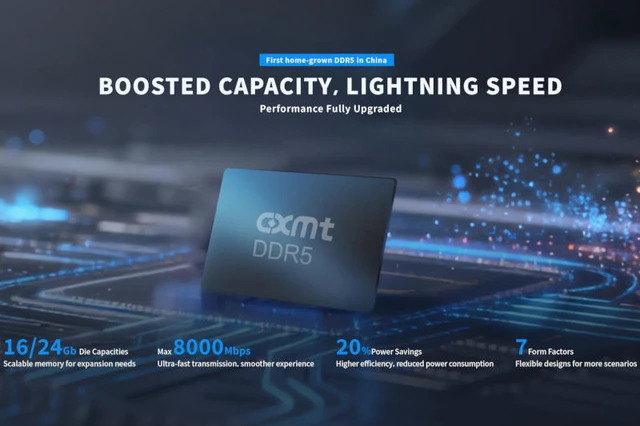 The Price of Acceleration: CXMT’s Rapid Push into Memory