While the industry is pivoting rapidly toward DDR5 and the AM5 socket, the AM4 platform continues to stand as the gold standard for stability and cost-effectiveness. The massive install base of Ryzen 5000-powered systems sustains a robust demand for high-quality upgrades, even for mature technology stacks. Gigabyte is addressing this need by integrating cutting-edge connectivity standards into its battle-tested solutions. The introduction of Wi-Fi 7 support for B550 motherboards effectively blurs the line between legacy hardware and the networking technologies of tomorrow.
Gigabyte’s return to the AM4 socket is less a regression and more a calculated strategic move for users who value the enduring reliability of the Ryzen 5000 series. The new B550 X lineup—spanning the Gaming, Eagle, and Aorus Elite families—covers both full-sized ATX and compact Micro-ATX form factors. This allows legacy system owners to modernize their hardware without the prohibitive cost of replacing the entire CPU and RAM ecosystem.
The technological centerpiece of this series is the integration of Wi-Fi 7. While previous B550 iterations were capped at Wi-Fi 6 and 6E, these updated boards unlock significantly wider data channels and reduced latency. This transforms the motherboard from a mere interconnect into a sophisticated network hub, capable of maintaining peak performance even in high-density wireless environments.
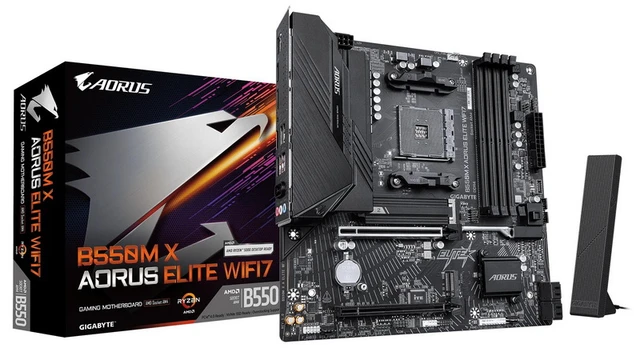
The B550M X Aorus Elite WIFI7 deserves particular scrutiny. Despite its compact Micro-ATX footprint, the board boasts formidable power delivery: a 10-phase VRM (8+2 configuration) ensures stable power delivery to the processor via a standard 8-pin EPS connector. This robust power stage guarantees stability and prevents voltage droops under heavy loads—a critical factor for multi-threaded workloads and high-end gaming.
Memory and storage follow a traditional yet highly efficient architecture. Four DIMM slots allow DDR4 capacity to scale up to 128GB at 3200 MHz. In terms of expandability, the board offers a balanced array: a primary PCIe 4.0 x16 slot with a quick-release mechanism for modern GPUs, complemented by a PCIe 3.0 x16 slot operating in x4 mode via the chipset. Storage is handled by two M.2 slots—one supporting PCIe 4.0 for ultra-fast NVMe drives and another with a PCIe 3.0 interface, allowing users to flexibly balance speed and capacity.
The I/O suite is meticulously designed to meet modern peripheral demands. The rear panel concentrates USB 3.2 Gen1 ports (including Type-C) and USB 2.0, alongside HDMI and DisplayPort outputs for integrated Ryzen graphics. For system administrators and enthusiasts, a dedicated BIOS update button enables firmware flashes without needing a CPU installed, paired with an intuitive quick-connect system for Wi-Fi antennas.
Audio performance is driven by the proven Realtek ALC1220 codec, delivering crisp sound and effective noise filtration. The networking stack is rounded out by the Realtek Wi-Fi 7 RTL8922AE controller, supporting 160 MHz channels and Bluetooth 5.4, alongside a standard 2.5 Gbps wired interface. Together, these specifications make the B550M X Aorus Elite WIFI7 an ideal foundation for those looking to maximize the potential of the AM4 platform without compromising on modern connectivity.
 The Price of Acceleration: CXMT’s Rapid Push into Memory