For years, modern robotics remained the exclusive domain of secluded laboratories and prohibitively expensive industrial systems. However, the emergence of accessible consumer platforms is shifting this paradigm, transforming complex machinery into instruments for widespread creative exploration. Pollen Robotics' Microduck serves as a compelling case study in the latent demand for open, programmable hardware. Beyond its eccentric aesthetic, the robot is laying the groundwork for a novel ecosystem centered on inter-machine skill sharing.
The commercial launch of Microduck served as a rigorous stress test for Pollen Robotics' production capabilities. Within the first six hours, sales hit the million-dollar mark, with pre-orders skyrocketing to $2.6 million within a single day. The $399 price point proved to be a sweet spot for developers and enthusiasts alike, triggering an immediate shortage. Consequently, the company was forced to revise its delivery timelines: while shipments were originally slated for the end of the year, new customers now face a lead time of four to six months.
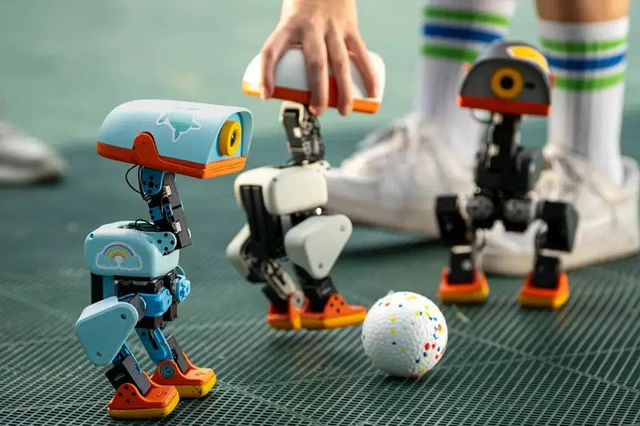
Microduck represents an evolutionary leap for Pollen, building upon the foundation of Reachy Mini. Where the previous project was a desktop system with a cubic head—requiring manual assembly and focusing on dialogue and gesturing—the new product shifts the interaction into the realm of active mobility. This bipedal, single-eyed robot moves with a characteristic waddle, making its behavior feel more organic and less predictable. Out of the box, Microduck can stand, sit, navigate its environment, interact with objects using its plastic beak, and even play soccer. Particularly noteworthy is its ability to self-right after a fall—a critical capability for any autonomous mobile robot. For those seeking expanded functionality, optional accessories allow the robot to tackle complex disciplines, including ice skating.
However, the true value of Microduck lies not in its basic kinetics, but in its openness to deep modification. Developers are granted access to a comprehensive sensor suite: a camera, LiDAR, and two inertial measurement units (IMUs). This transforms the device from a novelty into a legitimate research tool for studying navigation and spatial orientation. The only significant bottleneck remains battery life; the removable battery lasts approximately one hour of active operation, which is typical for compact devices with high servo density.
The technological breakthrough here is realized through the Sim2Real (Simulation to Real) paradigm. Rather than spending hundreds of hours on physical training—which would lead to rapid mechanical wear—developers can utilize a virtual model within a physics simulator. The trial-and-error learning process occurs in a digital environment, after which the optimized weights and algorithms are deployed to the physical hardware.
To facilitate global knowledge exchange, the platform utilizes the ONNX (Open Neural Network Exchange) format. This allows any successfully mastered skill—be it a complex dance or a specific gripping technique—to be converted into a portable file. In doing so, the community is building a shared library of "digital reflexes" that any Microduck owner can download and integrate, effectively mirroring the trajectory of Large Language Models (LLMs), where shared weights serve as the foundation for further fine-tuning.
 MSI Katana 15 HX and the Memory Paradox